For much of the past five years, one of the most consequential economic decisions in Uganda has not been made in Parliament or announced in a national budget. It has been made quietly inside bank boardrooms through a simple question: where should capital be deployed?
As Uganda navigated the economic uncertainty that followed the COVID-19 pandemic, commercial banks increasingly favoured Treasury Bills and Treasury Bonds over lending to businesses. Government securities offered predictable returns with relatively low risk at a time when inflation was rising, credit quality had deteriorated and many businesses were struggling to recover.
From a banking perspective, the strategy was rational. From an economic perspective, however, it carried significant implications.
Banks are the primary allocators of capital within an economy. Their decisions determine whether savings are channelled into financing government expenditure or invested in businesses that create jobs, expand production, increase exports and stimulate innovation. When more capital flows into government borrowing, fiscal operations are supported. When more capital reaches the private sector, economies tend to become more productive.
That balance matters because sustainable economic transformation depends not only on public investment but also on private enterprise.
There are now growing signs that Uganda’s banking sector may be entering a new phase.
Recent financial results from DFCU Limited suggest that at least one major lender is deliberately redirecting capital towards productive sectors of the economy. While the figures relate to a single institution, they raise a broader question about whether Uganda’s banking industry is gradually shifting from preserving capital to deploying it.
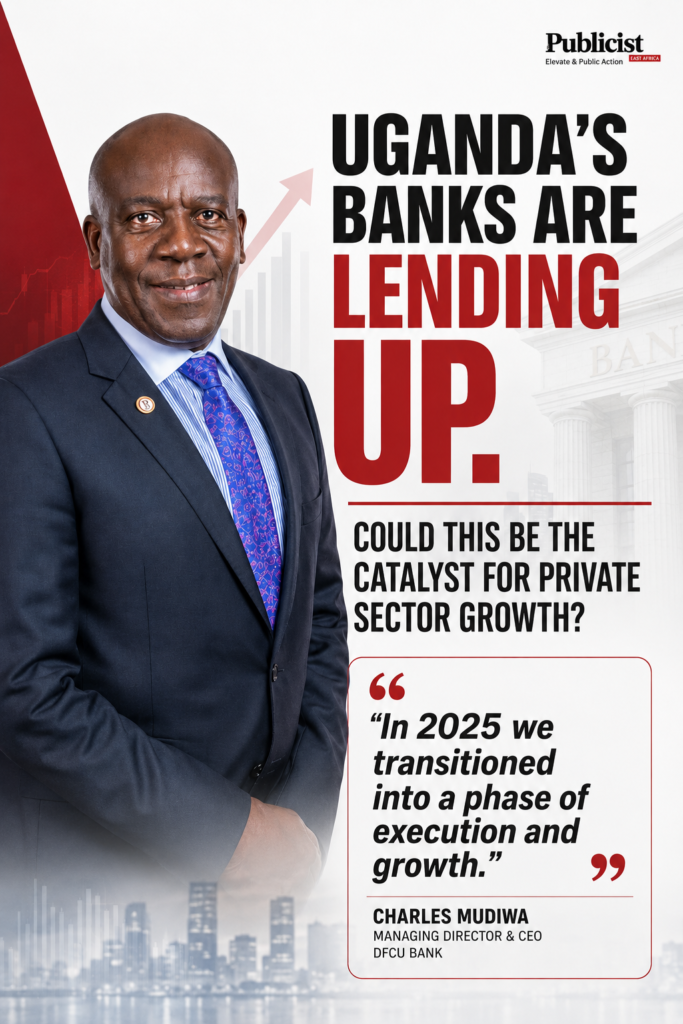
Managing Director and Chief Executive Officer Charles Mudiwa says 2025 marked a decisive turning point for the bank.
“In 2025 we transitioned into a phase of execution and growth,” Mudiwa said.
That transition is reflected in the bank’s performance. Customer loans increased by 12 percent to Shs1.265 trillion, while customer deposits grew by 15 percent to Shs2.71 trillion. Lending to small and medium-sized enterprises expanded by 63 percent, accompanied by a 25 percent increase in the number of borrowing customers. Profit after tax rose to Shs74.9 billion, supported by stronger lending and diversified income streams.
The numbers are significant not simply because they represent improved financial performance, but because they may indicate renewed confidence in Uganda’s productive economy.
The timing is important. Uganda’s macroeconomic environment has improved considerably over the past year. The Ministry of Finance projects economic growth of approximately seven percent during the 2025/26 financial year, supported by strong agricultural output, expanding services, increased construction activity and large-scale investments associated with the East African Crude Oil Pipeline, the Tilenga and Kingfisher oil developments.
At the same time, inflation has remained within the Bank of Uganda’s medium-term target, creating a more predictable investment environment for both lenders and borrowers. Commercial banks are operating with strong capital buffers, healthy liquidity positions and record profitability, providing greater capacity to expand lending without compromising financial stability.
These conditions raise the possibility that Uganda is entering a new credit cycle, one in which financing businesses becomes increasingly attractive after several years dominated by investment in government securities.
Such a transition would carry implications far beyond the banking industry. For years, economists and business leaders have argued that Uganda’s greatest constraint is not necessarily entrepreneurial ambition but access to affordable capital. Small and medium-sized enterprises, which account for more than 90 percent of private businesses according to the Uganda Bureau of Statistics, employ approximately 2.5 million Ugandans and contribute around one-fifth of the country’s Gross Domestic Product. Yet many continue to identify limited access to finance as one of the greatest barriers to expansion.
The challenge extends well beyond SMEs. Manufacturers require long-term financing to invest in machinery, automation and factory expansion. Agribusinesses need affordable credit for irrigation, storage, value addition and export processing. Tourism operators require investment to develop accommodation, transport infrastructure and new visitor experiences. Technology companies need patient capital to develop innovative products capable of competing within regional and global markets. Exporters depend on trade finance and working capital to take advantage of opportunities created by the African Continental Free Trade Area.
Each of these sectors represents an important pillar of Uganda’s long-term development strategy. Each also depends on a financial system willing to invest beyond the relative safety of government debt.
This is where the conversation intersects with Uganda’s broader economic ambitions. Over the past two decades, government has invested heavily in roads, electricity generation, industrial parks, digital infrastructure and logistics networks. These investments have created the physical foundations required for industrialisation and private sector growth.
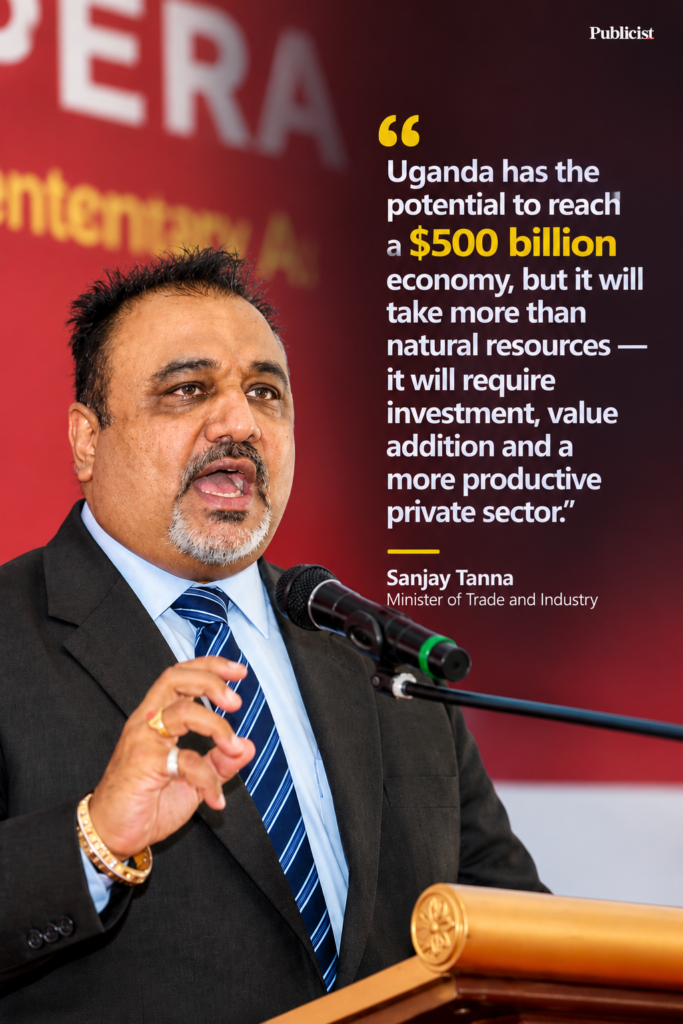
Trade Minister Hon. Sanjay Tanna recently argued that Uganda has already completed much of the infrastructure necessary to support rapid economic expansion.
“To achieve growth from $50–60 billion to $500 billion is now extremely easy. We already have the roads and infrastructure in place; all we need is funding,” Tanna said.
His observation captures an important reality. Infrastructure creates economic potential, but infrastructure alone does not generate prosperity. Roads do not manufacture products. Industrial parks do not establish factories. Electricity does not create exports unless businesses possess the capital required to invest, expand production and compete.
The next phase of Uganda’s economic transformation may therefore depend less on constructing additional infrastructure and more on ensuring that businesses can access the financing needed to utilise what already exists.
DFCU believes these conditions are already beginning to stimulate greater demand for credit.
General Manager Sophie Achak says the bank expects private sector borrowing to continue increasing.
“One of the key things we see is growing credit demand, given a suitable investment environment,” she said.
She added that future growth would require banks to evolve alongside technological change.
“The banking sector will need to respond to digital transformation, artificial intelligence and sustainability requirements while maintaining strong risk management.”
Her comments highlight another important shift taking place within financial services. Expanding lending cannot simply mean taking greater risks. It increasingly requires better data, improved credit assessment, digital banking platforms and artificial intelligence capable of helping banks understand customers more effectively while maintaining prudent lending standards.
Chief Financial Officer Rebecca Birungi said the bank’s stronger performance reflected both funded and non-funded income.
“Revenue growth was driven by lending income as well as fees, commissions, trade finance and foreign exchange activity,” she said.
She added that improved lending had been accompanied by stronger asset quality, with a significant reduction in the bank’s non-performing loan ratio. That improvement suggests banks are becoming more confident in extending credit without compromising financial discipline.
Whether dfcu represents an isolated example or the beginning of a wider industry trend remains to be seen.
Uganda’s commercial banking sector has reported record profitability in recent years, collectively earning more than Shs2 trillion in annual profits while maintaining strong liquidity and capital adequacy. Those financial fundamentals provide the capacity to increase lending if economic conditions continue to improve.
If more banks begin allocating larger portions of their balance sheets towards productive enterprise rather than government securities, the effects could be profound. Greater access to finance would enable businesses to invest in technology, increase production, create employment, expand exports and strengthen Uganda’s industrial base.
The significance of dfcu’s results therefore extends beyond one institution’s financial performance. They raise a more fundamental question about the future role of Uganda’s banking sector in national development.
For years, commercial banks have been rewarded for financing government borrowing. The country’s next stage of economic transformation may depend on whether they become equally committed to financing entrepreneurs, manufacturers, farmers, exporters and innovators.
Uganda has already laid much of the physical foundation for growth through investments in infrastructure, energy and industrial development. Reaching the country’s ambition of building a US$500 billion economy will increasingly depend on what happens after that infrastructure is built.
It will depend on whether businesses can access the capital required to transform opportunity into production, investment into exports and ambition into jobs.
Infrastructure creates opportunity. Capital determines whether that opportunity becomes economic transformation.