
One year ago, one of Uganda’s leading homegrown commercial banks embarked on one of the most significant transformations in its history. The institution formerly known as Post Bank Uganda unveiled a new identity as Pearl Bank, signalling far more than a change of name and corporate colours. It marked the beginning of a broader ambition to reposition the bank as a catalyst for financial inclusion, entrepreneurship and Uganda’s digital economy.
Twelve months later, the rebrand has entered a new phase. The focus is no longer on introducing a new identity, but on demonstrating how that identity is translating into greater access to finance, stronger support for enterprise and more inclusive economic growth.
The timing could hardly be more significant. According to the Bank of Uganda’s Annual Report 2024/25, Uganda’s economy expanded by 6.3 percent, making it one of the fastest-growing economies in the East African Community. The banking sector remained resilient, with non-performing loans declining to 3.7 percent, reflecting improving asset quality and growing confidence in the financial system.
Yet robust economic growth does not automatically translate into shared prosperity. Across Uganda, millions of farmers, youth entrepreneurs, traders and small businesses continue to face one persistent challenge: access to affordable, reliable and appropriate financial services.
For Pearl Bank, this is where it believes it can make the greatest difference.
“Our rebrand was more than a name change,” says Priscilla Akora, Head of Marketing and Communications. “It was a carefully thought-through strategy that reflects our broader vision and purpose of Fostering Prosperity for Ugandans.”
She explains that the new identity was designed to position Pearl Bank as “a digitally progressive, inclusive and nationally grounded financial institution,” while remaining true to its long-standing mission of serving Ugandans. The transformation, she says, reflects the bank’s readiness to embrace the future while ensuring long-term growth, relevance and impact.
Corporate rebranding is often viewed as a marketing exercise. However, the most successful transformations are rarely about logos or colours alone. They are about aligning an institution’s identity with its strategy, culture and long-term purpose.
For Pearl Bank, the choice of name was deliberate. Uganda has long been known as the Pearl of Africa, a phrase that reflects the country’s natural beauty, resilience, diversity and potential. By adopting the name Pearl Bank, the institution sought to anchor its identity in a story that is uniquely Ugandan.
“Pearls symbolise purity, wisdom, prosperity and trust,” Akora explains. “Those are values that align with our purpose as a Ugandan-owned bank.”
The decision also reflects a broader trend among African institutions that are increasingly embracing local identity as a competitive advantage. Rather than borrowing international narratives, they are building brands that resonate with local communities while projecting confidence on the regional stage.
Behind the new brand lies a broader strategic ambition. Pearl Bank’s direction is anchored on two priorities: expanding sustainable financial inclusion and stimulating entrepreneurship by ensuring that more Ugandans can access affordable, secure and relevant financial services.
This ambition aligns closely with Uganda’s development agenda. Agriculture remains one of the country’s largest employers, while the majority of Ugandans continue to operate within the informal economy. Despite steady economic growth, many micro, small and medium-sized enterprises still struggle to obtain affordable financing, limiting their ability to invest, create jobs and expand.
Closing this financing gap will be essential if Uganda is to realise its industrialisation ambitions and achieve long-term inclusive growth.
Rather than focusing solely on conventional banking products, Pearl Bank says it is increasingly supporting complete economic ecosystems.
Akora illustrates this through a typical agricultural value chain. Imagine a small maize farmer in Rakai. She accesses seasonal input financing at planting, sells to contracted buyers, receives payment directly into a Pearl Bank account, pays school fees through the Pearl Bank App and saves part of her earnings using the Wendi Mobile Wallet in preparation for the next planting season.
“This single chain drives financial inclusion and entrepreneurship,” Akora says.
The example reflects a broader shift taking place across African banking, where institutions are increasingly moving beyond lending to providing integrated financial ecosystems that combine credit, digital payments, savings and financial management.
If financial inclusion represents one pillar of Pearl Bank’s strategy, digital transformation is the other. As customer expectations evolve and fintech innovation reshapes the financial services landscape, banks are increasingly expected to provide seamless, secure and accessible services across multiple channels.
Pearl Bank has responded by expanding its digital ecosystem through the Pearl Bank App, Online Banking, USSD banking services and the Wendi Mobile Wallet.
At the same time, the bank continues to invest in physical infrastructure. Today, Pearl Bank operates a network of 59 branches, including its Head Office on Roscoe Road in Kololo, alongside 59 ATMs, more than 13,000 Wendi agents and 14 mobile banking vans serving communities across Uganda.
The combination of digital innovation and physical reach reflects the bank’s belief that meaningful financial inclusion requires customers to have multiple ways of accessing financial services, regardless of where they live.
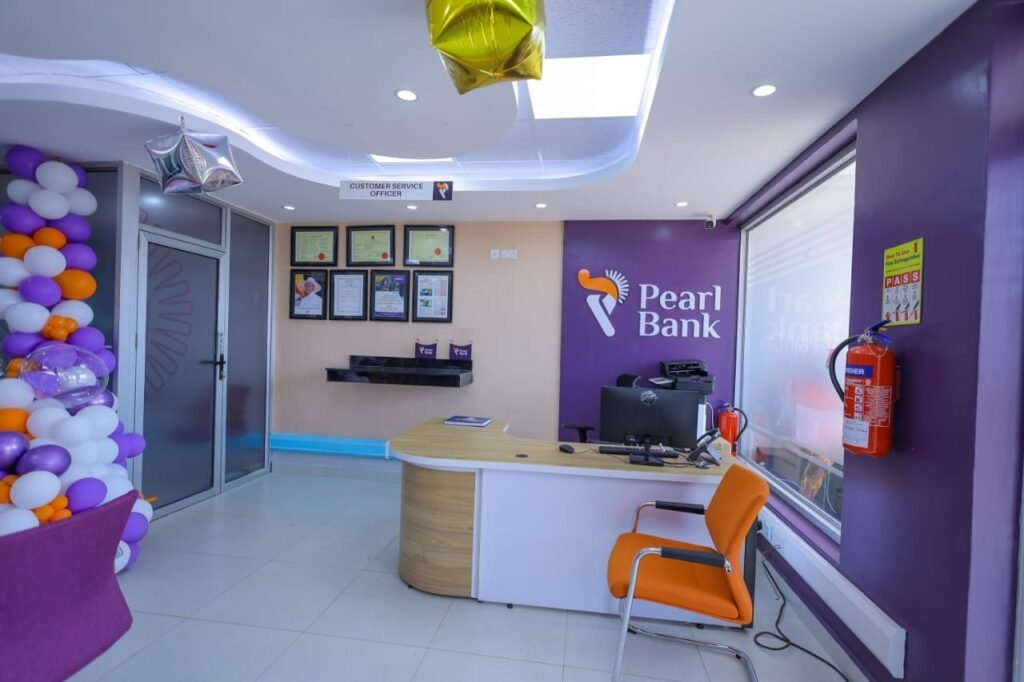
One year after the rebrand, much of the visible transformation has been completed. Branches, the head office, ATMs, digital platforms and customer touchpoints now carry the Pearl Bank identity, while legacy PostBank ATM cards and cheque books are gradually being phased out.
Customers are encouraged to replace their PostBank-branded cards and cheque books at their nearest Pearl Bank branch ahead of the announced transition timelines.
Yet management acknowledges that building a trusted brand extends well beyond updating physical assets.
“Rebrands are more than a name change and brand colours,” Akora notes. “You must constantly communicate and engage various stakeholders.”
That ongoing engagement, together with consistent customer experience, will ultimately determine how the new brand is perceived in the years ahead.
Uganda’s banking sector is evolving rapidly as digital innovation, financial inclusion and enterprise development increasingly shape competition.
Institutions that successfully connect capital with entrepreneurship, agriculture and household resilience will play an increasingly important role in supporting the country’s economic transformation.
One year after unveiling its new identity, Pearl Bank’s journey remains a work in progress. Yet the institution has already moved beyond changing its name to redefining its purpose.
Ultimately, the success of the rebrand will not be measured by refreshed signage or modernised branches. It will be measured by whether more Ugandans are able to access finance, grow businesses, invest in agriculture, educate their families and build lasting prosperity because a homegrown bank chose to grow alongside them.
That is the promise behind Pearl Bank’s purpose of Fostering Prosperity for Ugandans. And if that promise is realised, the transition from PostBank to Pearl Bank may well be remembered not simply as a successful rebrand, but as the beginning of a new chapter in Uganda’s banking story.