Climate change is forcing farmers across Uganda to make increasingly difficult decisions. The rains that once followed familiar patterns have become less predictable, seasons are shifting and extreme weather events are becoming more frequent. For millions of farmers who depend on agriculture for their livelihoods, the challenge is no longer simply producing food, but knowing when and how to farm in an increasingly uncertain climate.
Women farmers are particularly vulnerable. Although they play a central role in Uganda’s agricultural sector and contribute significantly to household food production, many still have limited access to the climate information needed to make critical decisions around planting, crop selection and farm management.
A recent conversation around the limited access women have to climate information highlights a deeper challenge facing agriculture: the growing gap between the data available and the farmers who need it most.
Artificial intelligence could become an important part of closing that gap.
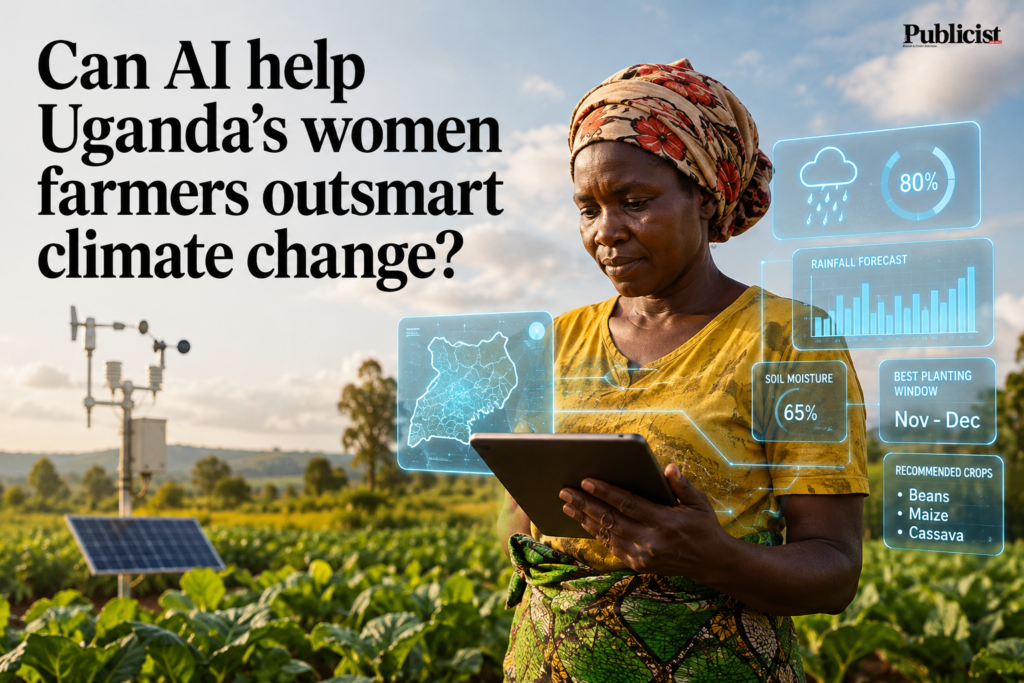
The technology is already changing how the world understands and responds to climate risks. By analysing large volumes of data from weather stations, satellites, soil monitoring systems and historical farming patterns, AI can provide more accurate predictions and translate complex information into practical recommendations for farmers.
For a smallholder farmer, the value of AI is not in the technology itself but in the decisions it can support. Knowing whether to plant earlier or delay planting, which crops are likely to perform better under expected conditions, or when a disease outbreak may occur can make the difference between a productive season and a devastating loss.
This represents a shift from traditional weather forecasting towards what experts increasingly describe as climate intelligence. Instead of simply telling farmers what the weather may look like, technology can help them understand what those conditions mean for their specific crops, location and farming practices.
Uganda has an opportunity to benefit from this emerging field. The country already has a growing digital ecosystem, expanding mobile connectivity and institutions working at the intersection of agriculture, research and climate science. Organisations such as the Uganda National Meteorological Authority, the National Agricultural Research Organisation and universities are contributing to the broader effort of improving access to agricultural information.
The next challenge is ensuring that these innovations reach the farmers who need them most.
A woman farmer in eastern Uganda, for example, may not need a complex digital platform. What she needs is a reliable message in a language she understands, informing her about expected rainfall patterns and advising her on the best farming decisions for the coming weeks. The power of AI lies in its ability to make sophisticated information simple, accessible and relevant.
However, technology alone cannot solve the climate information challenge. Barriers such as limited smartphone ownership, digital literacy gaps, affordability and unequal access to productive resources continue to affect women farmers. Without addressing these issues, digital solutions risk reaching only those who are already connected.
This is why collaboration between government, technology companies, financial institutions, development partners and agricultural organisations will be critical. Telecom companies can help deliver information through mobile platforms. Banks and insurers can use better climate data to strengthen agricultural financing and risk management. Agribusinesses can benefit from more predictable supply chains.
For the private sector, climate intelligence is becoming more than a social impact issue. It is increasingly an economic necessity. Better information can help farmers improve productivity, reduce losses and strengthen their ability to access finance.
The future of agriculture will depend not only on seeds, land and machinery, but also on access to timely and accurate information. As climate change makes traditional farming decisions more difficult, technologies such as artificial intelligence could help farmers move from reacting to weather events to preparing for them.
AI will not replace the knowledge and experience of farmers. Instead, its greatest contribution may be helping farmers combine generations of local knowledge with new scientific insights.
For Uganda’s women farmers, who remain at the centre of the country’s food systems, that combination could provide a powerful pathway towards greater climate resilience and economic opportunity.