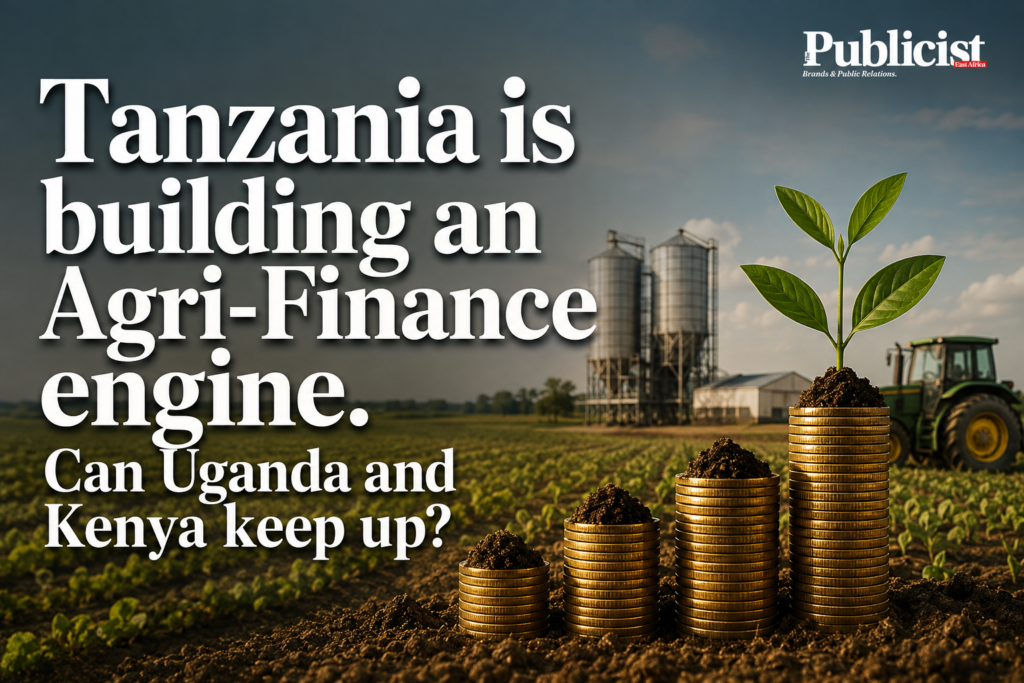
Tanzania’s agricultural development bank has just published numbers that are hard to ignore. The Tanzania Agricultural Development Bank (TADB) has disbursed Sh1.55 trillion to 862 projects, reaching more than 2.6 million people, and Sh1.32 trillion of that, 84 percent of the total, has gone out since President Samia Suluhu Hassan took office. But the more interesting number sits underneath the headline. TADB’s Sh108 billion credit guarantee fund has unlocked Sh692 billion in commercial lending from 21 financial institutions. Every shilling of public risk sharing capital has pulled in more than six shillings of private lending.
That ratio is the real story, and it raises an uncomfortable question for the rest of the region. Is anyone else in East Africa building anything close to it?
Tanzania’s approach rests on three moves happening at once. The government has been aggressively recapitalising TADB itself, taking its capital base from Sh60 billion to Sh452 billion, with the state contributing 87 percent of that increase. At the same time, the bank is using its own balance sheet less as a direct lender and more as a guarantor, absorbing the risk that has traditionally kept commercial banks away from agriculture. And the financing is being aimed deliberately at what happens after the farm gate, in storage, irrigation and agro-processing, rather than at production credit alone. The African Development Bank’s $60 million sovereign loan for on-lending as equity into TADB, approved this year, reinforces the same logic: strengthen the institution first, then let it do the work of pulling in other people’s capital.
TADB’s own strategy documents describe this as value chain financing, and Managing Director Frank Nyabundege has framed the goal explicitly as moving Tanzanian agriculture from subsistence toward commercial production. The bank says it now touches 57 value chains, from cashew and coffee to poultry and dairy, which suggests the strategy is not confined to a handful of flagship commodities but is meant to run across the sector.
Uganda Development Bank is the obvious point of comparison, and it has grown too. Its asset base stood at UGX 2.28 trillion, roughly US$613 million, as of December 2025, with a loan book of UGX 1.77 trillion. But UDB’s agricultural financing still reads primarily as direct lending, in the form of input finance, equipment and post-harvest infrastructure, rather than a guarantee mechanism built to crowd in commercial banks at a multiple of what government puts in. Programmes like Agri-Connect, a digital lending pilot for VSLA-linked smallholders run in partnership with FAO, the EU and UNCDF, show real experimentation at the retail end of the market. What is missing is a published Ugandan equivalent of TADB’s finding that every shilling of guarantee capital unlocks six more.
Where Uganda has moved more visibly this year is on infrastructure linked concessional finance rather than guarantees. The African Development Bank approved a $140 million loan in June 2026 for irrigation and agro-industrialisation in the Bunyoro subregion, expected to reach more than 121,000 households and generate over 13,000 jobs. That sits closer in spirit to TADB’s emphasis on storage and processing than to its risk transfer mechanism. It is a useful instrument, but a narrower one than a national guarantee fund.
Kenya’s Agricultural Finance Corporation tells a starker story about the financing gap itself. AFC Managing Director George Kubai has pointed out that commercial banks allocate only 3.6 percent of their lending portfolios to agriculture, and that annual demand for AFC credit runs above Sh200 billion against an approval capacity closer to Sh4.5 to Sh4.7 billion, meaning AFC can currently meet only a small fraction of what farmers and cooperatives are asking for. Its total loan portfolio stood at about Sh12.3 billion as of late 2025, an order of magnitude smaller than TADB’s disbursed totals even after accounting for the difference in economy size.
AFC is not standing still. It has launched a wholesale lending model that channels concessional capital through SACCOs and other intermediaries rather than lending retail to every farmer directly, which is a structural echo of TADB’s guarantee approach, using Kenya’s comparatively deep cooperative infrastructure as the transmission mechanism. Warehouse receipt financing, asset financing and structured value chain financing round out a toolkit that on paper looks similar to TADB’s ambitions. The government’s Sh10 billion medium term budget allocation and the Sh5 billion earmarked for livestock value chains under the Bottom up Economic Transformation Agenda suggest the political appetite is there. What is still missing is Tanzania’s demonstrated leverage ratio, a public number showing that public capital is pulling in a multiple of private lending at scale.
Line the three countries up and a pattern emerges. All three have identified the same underlying problem, which is that commercial banks under lend to agriculture because of collateral gaps and perceived risk, and that public development finance needs to do more than write cheques to farmers if it wants to fix that. All three are experimenting with intermediation, whether through guarantees, wholesale lending via cooperatives, or blended concessional infrastructure finance, rather than relying on pure direct credit.
The difference is how far each has got. Tanzania has a published leverage number and a recapitalised institution built specifically to use it. Uganda has the capitalised institution and infrastructure linked concessional finance, but not yet a guarantee mechanism operating at comparable scale, or at least not one with published multiplier data. Kenya arguably has the most sophisticated intermediation architecture, combining SACCOs, warehouse receipts and structured value chain products, but is so capital constrained that it is meeting only a small fraction of documented demand.
What to watch
For East Africa’s agricultural transformation story, the number worth tracking over the next twelve to eighteen months is not lending totals. It is leverage ratios: how much private capital each of these institutions can demonstrably pull in per unit of public risk sharing capital, and whether Uganda or Kenya eventually publish anything comparable to TADB’s finding that one shilling of guarantee capital can unlock more than six in private lending. Whichever development bank in the region gets that multiplier working, and gets a credible number on it, will have the strongest claim to be building not just an agricultural credit programme, but the financial infrastructure of a genuinely commercial agriculture sector.