For decades, East Africa’s fuel economy has been built around a simple reality, the region’s biggest markets are not necessarily located where fuel enters the continent. Kenya has been able to turn that geography into an advantage. Fuel arriving through the Port of Mombasa can move through the Kenya Pipeline Company’s network and into the landlocked markets that depend on imported petroleum products. Uganda, in particular, has become one of the biggest customers on that system. That gives Kenya something difficult to replicate: not just a port and pipelines, but an established supply chain connecting the coast to customers deep inside the region.
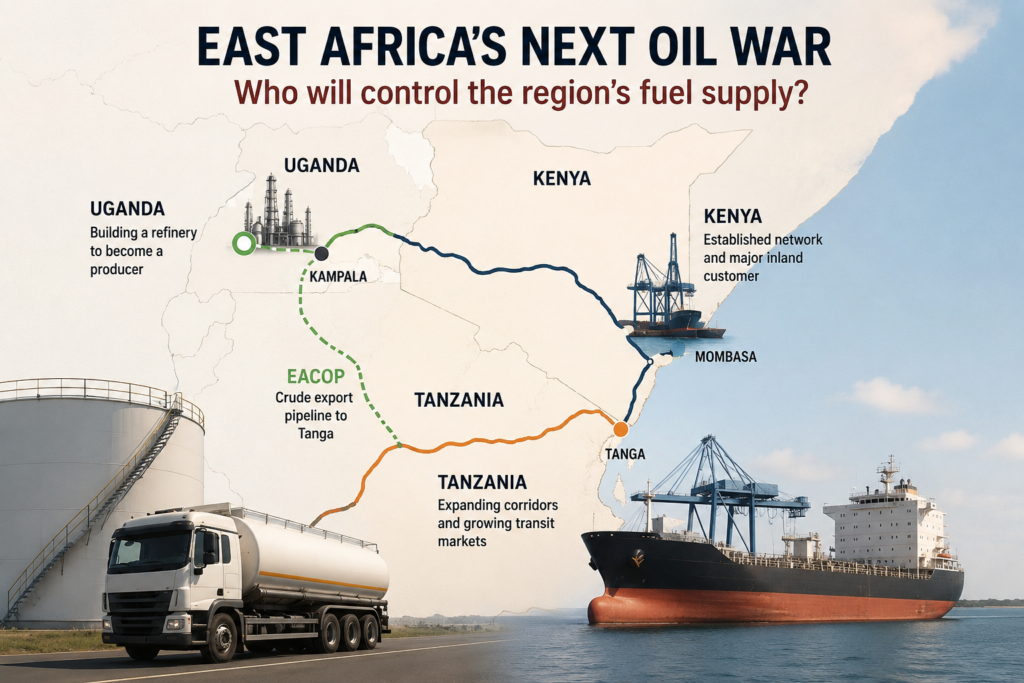
But the balance is beginning to change. Tanzania is expanding its own petroleum corridors through Dar es Salaam and Tanga, while Uganda is trying to reduce its dependence on imported refined fuel by building a refinery of its own. At the same time, Uganda’s crude is being connected to the Tanzanian coast through the East African Crude Oil Pipeline.
These developments are creating something East Africa has not had on this scale before, competing routes, competing infrastructure and, increasingly, competing visions of who should supply the region’s fuel.
The most consequential change could come from Uganda. Today, Uganda is both an oil producer and a major importer of refined petroleum products. Its crude comes from the Albertine region, but much of the fuel consumed in the country has to be brought in through regional supply chains.
That is why the proposed 60,000-barrel-per-day refinery at Kabaale in Hoima matters beyond Uganda’s borders. If the refinery is delivered and can produce competitively, Uganda could begin replacing some of the refined fuel it currently imports with domestically produced petrol, diesel, LPG, kerosene and aviation fuel.
And that immediately raises a question for Kenya: what happens to a corridor when one of its biggest customers starts producing some of the fuel it used to buy?
Uganda does not need to eliminate its imports for the effect to be significant. Even a partial substitution could reduce the volume moving through the Northern Corridor. And if the refinery eventually produces more than Uganda consumes, the direction of the trade could begin to change altogether.
Instead of fuel moving from the coast into Uganda, some petroleum products could potentially move out of Uganda towards neighbouring markets.
That would turn Uganda from primarily a customer in the regional petroleum system into a potential competitor within it.
But Uganda’s rise does not necessarily weaken Tanzania. In fact, Uganda’s oil strategy is simultaneously making Tanzania more strategically important.
The East African Crude Oil Pipeline will connect Uganda’s oilfields to Chongoleani near Tanga, providing the route through which Uganda’s crude can reach international markets. At peak capacity, the 1,443-kilometre pipeline is designed to transport 246,000 barrels of crude per day.
This is important because EACOP and the Northern Corridor are doing different jobs. EACOP is a crude oil export system. KPC’s network is largely designed around refined petroleum products. So Tanzania is not simply building a replacement for Kenya’s pipeline. It is becoming part of a different piece of Uganda’s petroleum strategy: the route that gets Ugandan crude to the coast.
At the same time, Tanzania is building a larger role in the movement of refined petroleum products into inland markets.
EWURA data shows that petroleum transit imports through Tanzania increased from about 4.91 billion litres in FY2023/24 to 6.37 billion litres in FY2024/25, an increase of nearly 30%.
That is significant growth. But it does not, by itself, prove that Tanzania is taking market share from Kenya.
The regional market may also be growing. The more important question is what happens next. Tanzania already has substantial transit markets. The Democratic Republic of Congo accounted for 37% of its transit petroleum imports, Zambia 33%, Rwanda 14% and Malawi 12%.
As these flows grow, Tanzania gains something that matters just as much as infrastructure: customers.
And this is where the competition between the three countries becomes more complicated. Kenya has the established network and a major inland customer in Uganda. Tanzania is building deeper links with markets further west and south. Uganda wants to become both a producer and a consumer, while its crude export route runs through Tanzania.
The three countries are therefore not competing over exactly the same thing. They are competing over different parts of the same regional energy system.
And ultimately, customers will decide which corridors matter.
A fuel trader moving product to Kampala does not necessarily care which country has the largest port. A manufacturer in Kigali does not care who built the longest pipeline. What matters is the final cost and reliability of getting fuel to the factory.
That means the real competition will be measured in landed cost.
How much does it cost to bring fuel through the port? How much does storage add? What are the pipeline tariffs? How expensive is the final road journey? How reliable is the route? How quickly can a shipment move through the system? And what taxes and other charges are added along the way?
These details can determine whether a corridor succeeds or fails.
A country can build an impressive pipeline and still lose business if another route can deliver fuel more cheaply and reliably. That is why Tanzania’s growing transit volumes matter, but they are not enough on their own to establish that Kenya is losing its position. And it is why Uganda’s refinery could be disruptive without necessarily destroying the Northern Corridor.
The real question is whether each system can compete on cost, reliability and scale. The prize is large because fuel is not simply another commodity. Tanzania alone consumed about 5.12 billion litres of petroleum products in FY2024/25, with transport accounting for 61.8% of consumption.
Across the region, petroleum is embedded in almost every economic activity: trucks moving goods across borders, farmers transporting produce, factories running machinery, construction companies moving materials, mines operating equipment and airlines carrying passengers.
Whoever can supply that fuel efficiently has an influence that extends far beyond the energy sector.
That is why East Africa’s petroleum map is changing. Kenya is trying to protect an established system built around Mombasa, pipelines and a large inland customer base. Tanzania is expanding alternative routes and strengthening its links with inland markets, while Tanga gains new strategic importance through EACOP. Uganda is attempting the most fundamental change of all: moving from being a major fuel importer to becoming an integrated petroleum producer, with crude production, an export pipeline and ambitions for domestic refining.
None of these countries has complete control of the regional supply chain.
And perhaps that is the most important point.
The next petroleum battle in East Africa will not necessarily be about one country defeating another. It may be about which combination of infrastructure, prices and partnerships becomes the most attractive to the region’s consumers.
Kenya has the head start. Tanzania has the alternative. Uganda has the potential to disrupt the existing pattern.
What happens next will depend less on who builds the biggest piece of infrastructure and more on who can connect the source of the fuel to the customer at the lowest competitive cost, and keep doing it reliably.
The next petroleum battle in East Africa will therefore not be fought with armies.
It will be fought with ports, pipelines, storage tanks, refineries, tariffs, prices and access to customers. And the country, or corridor, that performs that job most efficiently could have the greatest power to shape the economics of regional fuel supply.