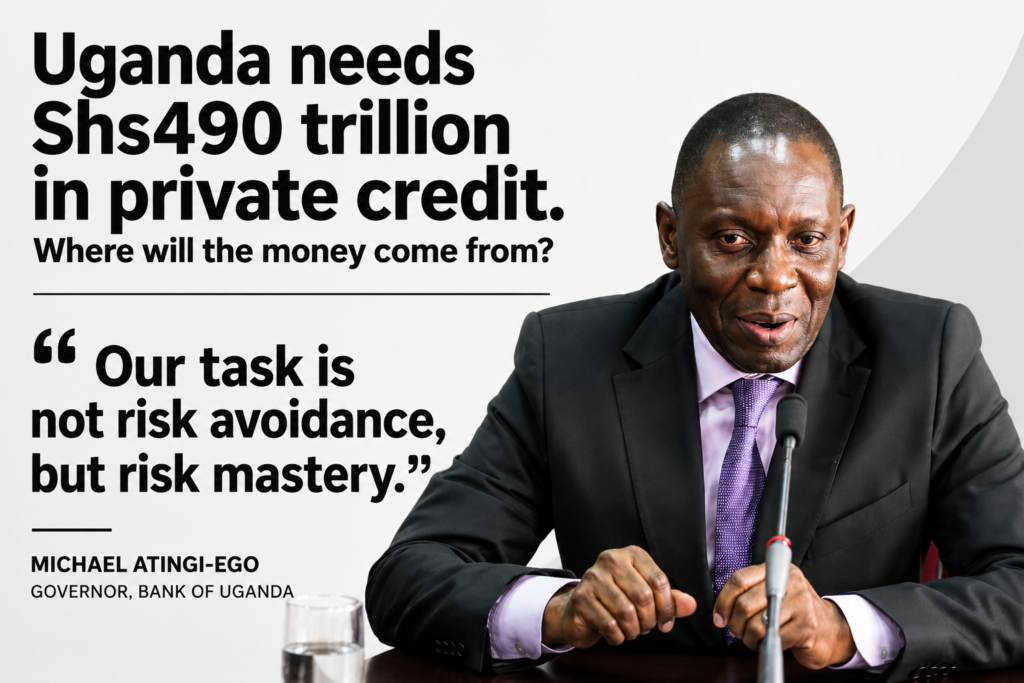
Uganda’s US$500 billion economic ambition comes with a financial requirement that is almost as striking as the target itself, private-sector credit will have to rise from roughly Shs30 trillion today to more than Shs490 trillion by 2040.
That means the financial system must support an expansion of more than Shs460 trillion in private-sector credit over the next 14 years. The Bank of Uganda says the ratio of private-sector credit to GDP, currently about 12.4%, will need to move towards 50%.
The question, therefore, is no longer simply whether Uganda can grow fast enough to become a US$500 billion economy. It is where the money will come from to finance that economy.
Governor Michael Atingi-Ego has put the challenge directly to Uganda’s financial institutions. Speaking at the second annual research conference of the Uganda Institute of Banking and Financial Services, he directed supervised institutions to submit board-approved strategies showing how their business models, capital positions and risk appetites will evolve to support the Tenfold Growth agenda.
“Our task is not risk avoidance, but risk mastery,” Atingi-Ego said.
He also challenged financial institutions to “build the capital, the risk governance, and the balance sheet capacity to lend at a scale and pace this country has not previously attempted.”
The scale of the ambition is significant. Uganda’s economy was estimated at Shs224.2 trillion, equivalent to US57.5billion,inFY2024/25,whileGDPisprojectedatShs250.9trillion,orUS63.6 billion, in FY2025/26. Government’s Tenfold Growth Strategy aims to take the economy to US$500 billion by 2040.
Achieving that will require factories to expand, farms and agro-processors to invest, infrastructure to be built, exporters to scale and new businesses to emerge. Each requires capital, but not necessarily the same kind. That is why Uganda’s financing challenge extends well beyond commercial banks.
Commercial banks will remain at the centre of the transformation. They already provide the largest formal source of private-sector credit, and lending conditions have begun to improve. Bank of Uganda’s March 2026 State of the Economy Report showed that private-sector credit growth had strengthened across several major sectors in the three months to February.
But even stronger annual credit growth will not, by itself, bridge the enormous gap between today’s lending base and the Shs490 trillion target.
Banks will need stronger capital positions, larger and more stable deposit bases, better credit assessment systems and greater capacity to finance long-term investments.
That also means managing a difficult balance. Banks must lend more without weakening the quality of their loan books.
A rapid expansion of credit that is not matched by stronger risk management could produce rising non-performing loans and undermine financial stability. For Atingi-Ego, the answer is not to avoid risk altogether, but to become better at understanding and managing it.
The second pool is longer-term institutional money. Uganda’s retirement benefits sector now manages an estimated Shs30 trillion in assets, according to Atingi-Ego. He has argued that the country will need to mobilise more than Shs400 trillion in patient capital to support supervised financial institutions in providing an estimated Shs490 trillion in working capital for businesses, infrastructure and job creation.This is important because not every investment Uganda needs can be comfortably financed through conventional bank lending.
A factory may take years to reach full production. A power project requires long-term capital. Agricultural infrastructure can take several seasons to generate returns. Housing and major transport projects require financing that matches the lifespan of the asset.
Pension funds and insurers, alongside other institutional investors, can potentially provide the longer-term money needed to complement bank lending. But that will require deeper capital markets, stronger investment governance and instruments that allow domestic savings to flow into productive assets.
Development finance institutions also have a role to play. Their value is not simply in providing another source of loans. DFIs can help finance projects that commercial banks may initially consider too risky, too long-term or too capital-intensive.
They can also help crowd in private investment by sharing risk, providing longer-tenor financing and supporting sectors where commercial lending remains limited.
That could be particularly important for agro-industrialisation, manufacturing, infrastructure and emerging businesses that need capital before they have the track record normally demanded by commercial lenders. The objective should not be for DFIs to replace commercial banks, but to help create projects and businesses that eventually become attractive to mainstream private capital.
Uganda will also need to move beyond a financial system dominated by bank lending. Capital markets can mobilise money from investors for companies and projects without placing the entire burden on bank balance sheets. Equity financing can also be particularly valuable for businesses that are growing rapidly but cannot comfortably take on more debt.
Private equity and other forms of private capital can provide another layer of financing, particularly for companies with strong growth prospects but insufficient collateral or operating history for conventional bank loans.
This is where the development of Uganda’s financial infrastructure becomes critical.
At the launch of Centenary Bank’s custodial services in May, Atingi-Ego linked stronger financial infrastructure to the mobilisation of long-term domestic and international investment. He argued that professional custody arrangements can strengthen transparency, investor confidence and the efficient allocation of long-term capital.
The broader message is clear: Uganda cannot mobilise hundreds of trillions of shillings in additional capital without building the institutions and markets that investors trust.
Foreign direct investment will also remain important. Uganda cannot realistically expect domestic savings alone to finance the full scale of its transformation. Foreign investors can provide capital, technology, management expertise and access to international markets.
The opportunity is particularly significant in sectors identified under the Tenfold Growth Strategy, including agro-industrialisation, tourism, mineral-based industrialisation, oil and gas, and science, technology and innovation.
But foreign capital is not a substitute for domestic financial development. Investors still need functioning capital markets, predictable regulation, credible institutions and businesses capable of deploying capital productively.
The stronger Uganda’s domestic financial system becomes, the more effectively it can absorb and multiply foreign investment.
Yet there is another side to the Shs490 trillion question that could prove just as important as finding the money.
Uganda needs more bankable businesses and projects capable of absorbing that capital productively. This may ultimately be the harder challenge.
Uganda Bankers’ Association Executive Director Wilbrod Owor recently noted that only about 70,010 registered entities currently access credit from banks, compared with an estimated 437,000 that would need access to credit to absorb the levels of financing envisaged under the Tenfold Growth ambition. That gap tells a different story from the headline numbers. It suggests Uganda does not simply need banks with bigger balance sheets. It needs a much larger pipeline of credible borrowers.
A small manufacturer may have orders but inadequate records. An agribusiness may have a viable market but lack collateral. A farmer may own productive assets but have irregular cash flows. A growing technology company may have strong prospects but few conventional assets against which to borrow.
For lenders, these businesses can be difficult to assess. That is why financial formalisation matters. Digital payments, transaction histories, alternative credit scoring and better financial records can allow lenders to assess businesses on actual cash flows rather than relying almost entirely on traditional collateral.
If more businesses can demonstrate reliable revenues, maintain proper accounts and build verifiable financial histories, the potential pool of productive borrowers becomes much larger.
The challenge is particularly acute in agriculture, where seasonal income, weather risk, commodity-price volatility and fragmented production make conventional lending more difficult.
This is ultimately where the Tenfold Growth financing question becomes more complicated. Uganda can increase credit without necessarily increasing productivity. A larger loan book is not automatically a larger economy. The additional capital must finance investments that expand production, improve productivity, create jobs, increase exports and raise incomes. That is why the quality of credit matters as much as its quantity.
The country will need financing for factories, storage facilities, transport networks, energy, technology, agricultural value chains and businesses capable of competing beyond Uganda’s borders.
It will also need regulation that allows financial institutions to innovate while protecting the stability of the system. Atingi-Ego has called for regulation that is “proportionate and forward-looking”, arguing that regulation should balance financial stability with the need to support investment.
“Regulation, done well, is the mechanism that lets ambition and safety advance together,” he said.
There is also the question of how efficiently existing capital moves through the economy. Atingi-Ego has pointed to prolonged commercial disputes that can leave money tied up in litigation, preventing capital from being invested, repaying creditors or being deployed elsewhere.
So the financing challenge is not simply about creating more money. It is about making capital available, affordable, investable and productive.
The US$500 billion target therefore represents a test not only of Uganda’s productive capacity but of its financial architecture. Commercial banks will have to expand their balance sheets and improve their ability to price risk. Pension funds and insurers will need to unlock more long-term savings. Development finance institutions will have to help crowd capital into strategic sectors. Capital markets and private equity will need to become more significant sources of business and infrastructure financing. Foreign investors will need reasons to bring capital into Uganda and confidence that it can be deployed efficiently.
And businesses themselves will have to become more transparent, productive and capable of absorbing larger amounts of financing. Uganda’s financial system is already evolving. The question is whether it can evolve fast enough.
The government has set the destination. The Bank of Uganda is now asking financial institutions to show how they intend to participate. The numbers make clear that this will require a financial expansion on a scale the country has not previously attempted.
For Uganda to reach US$500 billion by 2040, its financial system will have to do something more difficult than simply increase lending. It will have to turn savings into productive investment at scale, bring hundreds of thousands more businesses into the formal financial system and ensure that capital reaches the sectors capable of transforming the economy. Because a larger loan book does not automatically create a larger economy. The real question is whether Uganda’s financial system is deep enough to finance the journey.