Uganda wants more of the world to come to her and more of what it produces to reach the world. That ambition is increasingly visible in its plans to grow tourism, expand exports and use major international events such as the 2027 Africa Cup of Nations (AFCON) to attract spending, investment and international attention.
But there is a less visible part of that ambition that could determine how much Uganda actually captures: its ability to move people and goods efficiently through its main international gateway.
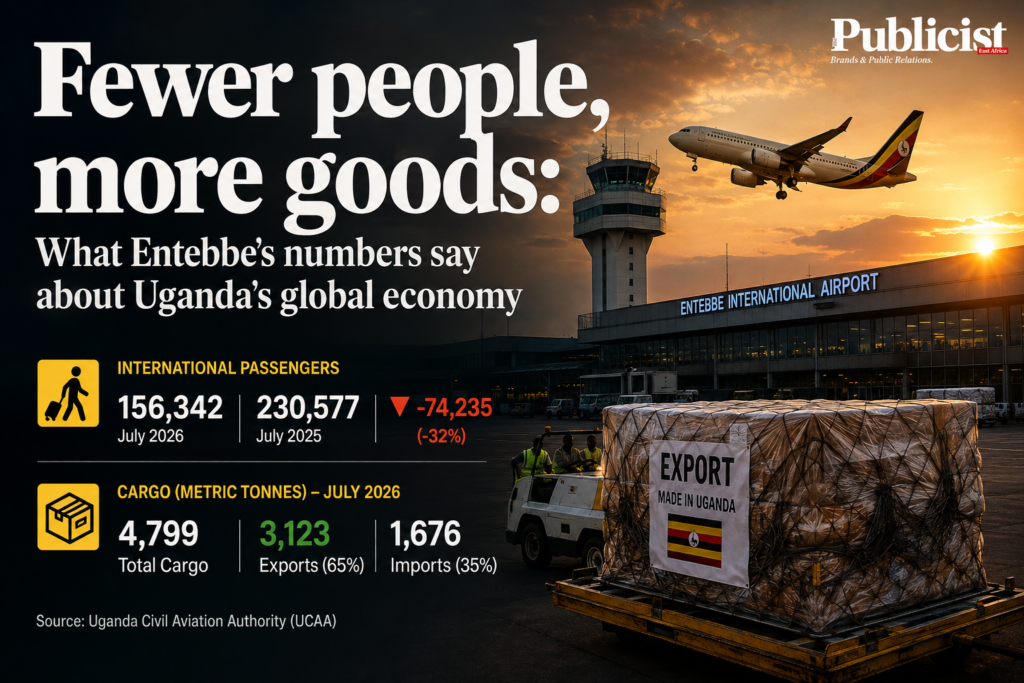
The latest figures from the Uganda Civil Aviation Authority (UCAA) present an interesting contrast. Entebbe International Airport handled 156,342 international passengers in July 2026, up from 131,246 in June, a monthly increase of about 19 percent. But the July figure remains significantly below the 230,577 passengers recorded in July 2025, when Entebbe registered its highest-ever monthly passenger traffic. That leaves a gap of 74,235 passengers, or about 32 percent.
The first-half numbers show that this is not simply a July anomaly. Between January and June 2026, Entebbe handled 1.01 million international passengers, compared with 1.13 million during the same period in 2025. At the same time, commercial aircraft movements increased by nearly 11 percent, according to UCAA.
So Uganda’s international passenger traffic is recovering month to month, but it has not returned to last year’s levels.
Then there is the other side of the airport’s business. Entebbe handled 4,799 metric tonnes of cargo in July 2026, up from 4,140 tonnes in June. Exports accounted for 3,123 tonnes, about 65 percent of the month’s cargo, against 1,676 tonnes of imports.
That creates a more interesting economic picture: fewer people than a year ago, but a substantial volume of goods moving outward.
For an economy trying to increase exports, that matters. Uganda does not earn export revenue simply because a product is produced. The product has to reach a buyer. For fresh produce, fish, flowers and other time-sensitive goods, the reliability and cost of airfreight can directly affect competitiveness. Uganda’s first-half 2025 data, for example, showed 22,844 tonnes of exports moving through Entebbe, alongside 10,778 tonnes of imports.
The bigger question, therefore, is not whether Entebbe had a good or bad month. It is whether Uganda’s international gateway is keeping pace with the economy the country wants to build. That question becomes harder to ignore as Uganda prepares for AFCON 2027.
Officials involved in the tournament preparations project that between 500,000 and 650,000 visitors could come to Uganda during the tournament. The Local Organising Committee has estimated that if each visitor spends at least $1,000, the tournament could generate at least $500 million in local economic activity. These are projections, not guaranteed returns.
But even if the projection materialises, visitors do not create economic value simply by crossing the border. They need flights. They need hotels. They need transport. They need restaurants, tours, entertainment and other services. Businesses need to be able to capture their spending. That makes Entebbe part of the AFCON economic equation long before a match begins.
The same is true for investors and exporters. An investor arriving in Uganda is entering through the same international connectivity system that an exporter depends on to reach overseas markets. This is why the passenger gap deserves more attention.
Why is Entebbe still 74,235 international passengers below July 2025, despite the month-on-month recovery?
The available figures establish the gap, but they do not explain it. UCAA should be pressed on whether the decline is linked to airline capacity, route changes, fares, seasonal patterns, weaker demand or shifts in regional travel. The fact that aircraft movements increased even as passenger numbers fell makes that question particularly important.
That is where the story moves beyond aviation. Uganda’s competitiveness increasingly depends on how easily people, capital and goods can cross its borders. An airport is therefore not just transport infrastructure. It is part of the country’s trade and investment infrastructure.
The cargo numbers offer one encouraging signal. Exports made up the larger share of July’s cargo, suggesting that Entebbe is supporting the movement of Ugandan goods into international markets.
But volume alone is not enough. The more important questions are what those goods are, where they are going, how much exporters are paying to move them, how quickly they reach markets and whether the resulting export revenues justify the cost of using airfreight.
Those are the questions that determine whether connectivity is actually creating competitiveness. AFCON simply gives Uganda a deadline by which some of those weaknesses will become more visible. The country expects a major increase in international visitors in 2027 while simultaneously trying to deepen its export base and attract more investment. Government has already committed additional funding to AFCON preparations, including infrastructure, transport and other supporting sectors.
The challenge is to ensure that this infrastructure does not only serve a tournament. It should help Uganda handle a larger economy after the tournament is over. The July figures therefore tell two stories at once. Passenger traffic is recovering, but remains well below last year’s exceptional level. Cargo volumes are rising, with exports accounting for the larger share.
For Uganda, the real test is not how many passengers or tonnes pass through Entebbe. It is what value the economy captures from those movements.
Can a passenger arriving at Entebbe become a hotel booking, a tour, a restaurant transaction or an investment? Can cargo leaving Entebbe become a profitable export, a new international customer and higher foreign-exchange earnings? And can Uganda build the airline connections, cargo systems and supporting infrastructure needed to make both possible?
That is the bigger meaning of Entebbe’s numbers. Uganda is not simply trying to move more people and goods. It is trying to earn more from being connected to the world.