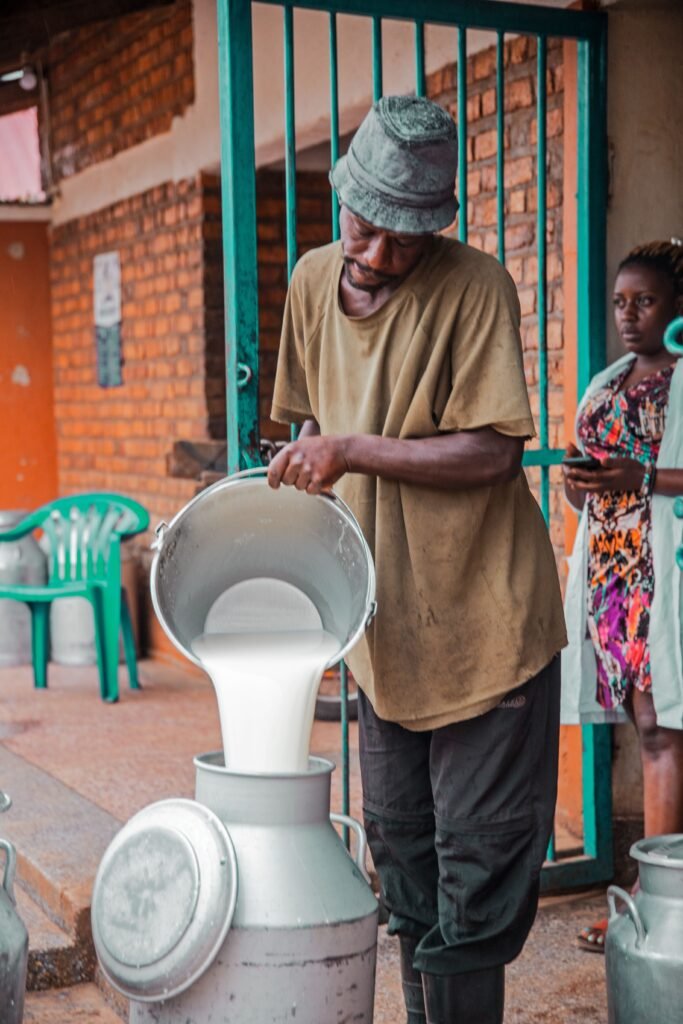
Kenya’s milk shortage has exposed a contradiction at the heart of East Africa’s food economy: one of the region’s largest dairy producers is struggling to meet consumer demand while its neighbour, Uganda, continues to produce enough milk to maintain a substantial surplus.
The problem is increasingly less about whether the region has milk and more about whether East Africa can move it efficiently across borders.
Kenya’s Trade, Investments and Industry Cabinet Secretary Lee Kinyanjui acknowledged on September 5 that the country is currently unable to meet domestic milk demand and is importing milk from neighbouring countries, including Uganda. He described the situation as unsustainable and said the government wants to support Kenyan farmers to restore self-sufficiency.
The admission comes as Kenya’s formal milk supply continues to weaken. According to the Kenya Dairy Board, deliveries to processors fell from 84.4 million litres in June 2026 to 81.3 million litres in July, a 3.7 per cent decline. Preliminary indications suggest the decline continued into August.
The pressure is being driven largely by prolonged dry and cold conditions, which have reduced pasture and increased the cost and scarcity of animal feed. Kenya’s Consumers Federation has also reported that formal-sector milk intake in June was 6.4 per cent below the level recorded in June 2025.
The impact is being felt by consumers. Reports from Nairobi have pointed to reduced stocks, delayed replenishment and higher retail prices, with some outlets limiting purchases as supplies tighten.
Yet across the border, Uganda remains one of the region’s important dairy suppliers.
Uganda’s Ministry of Agriculture, Animal Industry and Fisheries records national milk production at 5.4 billion litres in 2024, up from 2.7 billion litres in 2020. The same data shows that the value of Uganda’s milk and milk-product exports rose from $264.5 million in 2023 to $285.4 million in 2024.
More recent reporting indicates that Uganda has maintained production at about 5.4 billion litres annually, equivalent to roughly 15 million litres a day, despite the current dry conditions. That output remains sufficient for domestic consumption while keeping processing plants supplied.
But there is an important qualification: Uganda is not immune to the same weather shock.
Dry conditions have already pushed milk prices sharply higher in parts of Uganda. In Ankole and Kigezi, the price of a litre of milk has reportedly risen from about Shs1,000–1,500 before the dry spell to as much as Shs2,500–3,000 in some markets.
In Ntungamo, one of Uganda’s major dairy-producing areas, daily milk output has reportedly fallen from as much as 90,000 litres during the rainy season to around 40,000 litres. The decline has been attributed to depleted pasture and water sources, alongside Foot and Mouth Disease.
That makes Kenya’s current shortage particularly revealing.
Uganda has production capacity, Kenya has a large consumer market, and the two countries share a major land border. Yet the movement of dairy products between them has repeatedly been disrupted by trade restrictions, permits and other non-tariff barriers.
The East African dairy trade has a history of precisely this problem. Uganda has previously complained about restrictions on its milk entering Kenya, while Kenya has at various times sought to protect its own dairy farmers from imports.
Now the market has turned the question around. Kenya needs milk. Uganda is one of the countries capable of supplying it.
But even as Kenyan consumers face shortages, Uganda’s dairy industry continues to encounter restrictions that make access to the Kenyan market more complicated than the geography would suggest. Industry representatives and officials have pointed to export permits and other trade barriers as constraints on the movement of Ugandan milk into Kenya.
This is where the milk shortage becomes bigger than dairy. It becomes a test of what the East African Community Common Market actually means during a food-supply shock.
Regional integration is often measured through tariffs, customs procedures and political agreements. But food security requires something more practical: when one country has a shortage and another has a surplus, can food move from one market to the other quickly enough to stabilise prices and protect consumers?
Milk provides an unusually sharp test because it is highly perishable.
A truck carrying fresh milk cannot sit indefinitely at a border while paperwork, permits or regulatory questions are resolved. Every delay raises costs, threatens quality and undermines the commercial case for cross-border trade.
That makes the current crisis an opportunity to rethink how East Africa handles essential food commodities.
For Kenya, imports from Uganda can provide short-term relief while drought continues to constrain local production. For Uganda, the Kenyan shortage represents a market opportunity for farmers, processors, transporters and exporters.
But the opportunity should not be reduced to sending more raw milk across the border.
Uganda’s dairy industry has increasingly moved towards value addition, exporting products such as UHT milk, milk powder, casein and whey proteins. The country’s dairy export earnings reached $285.4 million in 2024, demonstrating the growing importance of the sector beyond the domestic market.
Longer-life dairy products could also make regional trade less vulnerable to border delays and logistical constraints. UHT milk and milk powder can be stored and transported more easily than raw milk, allowing producers to respond to regional shortages without depending entirely on the movement of highly perishable fresh products.
There is therefore a larger industrial opportunity for Uganda: not simply to become Kenya’s emergency milk supplier, but to build a regional dairy-processing hub.
For Kenya, meanwhile, the current shortage is a warning that food self-sufficiency cannot be understood only through national production figures. Feed supply, climate resilience, processing capacity, farmer incentives and regional trade all determine whether milk actually reaches consumers.
The crisis also demonstrates the limitations of treating neighbouring dairy producers primarily as competitors.
Kenya and Uganda will continue competing for farmers, processors and markets. But when weather shocks hit different parts of the region at different times, the same countries can also become each other’s buffers.
That is the logic behind a functioning regional food market.
East Africa does not necessarily need every country to produce everything it consumes. It needs countries with comparative advantages to be able to supply one another efficiently when markets require it.
Kenya’s current shortage offers a real-world test of that principle.
If Kenya cannot meet demand, and Uganda has the capacity to supply part of the gap, then the question should not simply be how quickly Kenya can restore domestic production. It should also be how quickly the region can make legitimate cross-border food trade work.
The immediate solution may be more milk from Uganda. The longer-term solution is a more integrated East African dairy market, one in which farmers can produce for a regional market, processors can invest with greater certainty, and essential food can move across borders without becoming trapped by the very boundaries regional integration was supposed to make less important.
Kenya needs milk. Uganda has the capacity to provide some of it. The real test is whether East Africa can get the milk where it is needed.
Editorial Note: Uganda’s agricultural future will be determined not only by what farmers produce, but by how effectively the country mobilises capital, builds markets, and creates institutions capable of converting production into wealth. This article is part of an ongoing Publicist East Africa series exploring that transition.