Reports of workforce reductions within the East African Crude Oil Pipeline (EACOP) project have understandably sparked concern among many Ugandans who viewed the country’s emerging petroleum industry as a long-term source of employment and economic opportunity. Yet the layoffs themselves may not be the real story.
What they reveal is that Uganda’s oil sector is entering a phase that industry experts have anticipated for years but one that often receives far less public attention than construction milestones, investment announcements, and first-oil countdowns: the transition from construction to operations.
For much of the past decade, Uganda’s petroleum industry has been defined by activity on the ground. Roads have been built across the Albertine region. Industrial facilities have risen from previously undeveloped sites. Thousands of workers found employment directly through project contractors and indirectly through suppliers, transport companies, accommodation providers, catering businesses, and other enterprises supporting the Tilenga, Kingfisher, and EACOP developments.
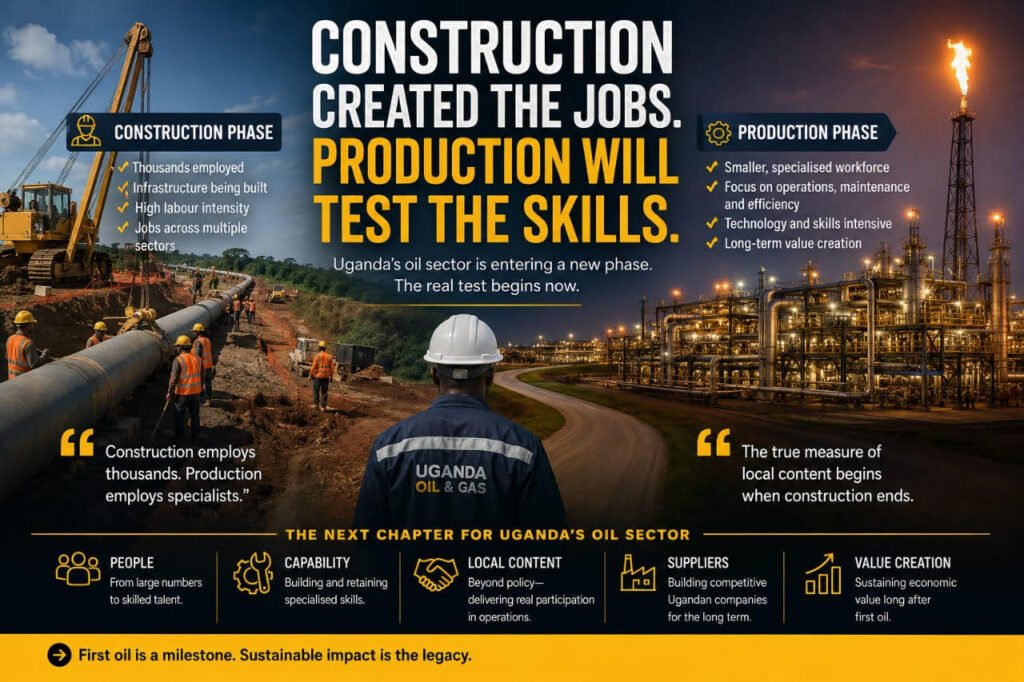
Construction creates jobs because assets must be built. Production is different.
Once infrastructure is completed, the workforce required to operate and maintain it becomes significantly smaller, more specialised, and increasingly technology-driven. The focus shifts from civil works and installation to operational efficiency, safety management, maintenance, logistics, environmental monitoring, and production optimization.
This transition is neither unusual nor unique to Uganda.
Across the global petroleum industry, employment typically peaks during construction before declining as projects move into production. Countries such as Ghana, Angola, and more recently Guyana have all experienced similar workforce adjustments as major oil developments moved from building infrastructure to operating it.
Viewed through this lens, the recent layoffs should not be seen solely as a story about jobs lost. They should also serve as a catalyst for a broader national conversation about what comes next for Uganda’s oil economy.
For years, local content has been one of the defining pillars of Uganda’s petroleum policy. Government, regulators, operators, and training institutions have invested heavily in developing Ugandan talent, strengthening local supplier capacity, and ensuring that national participation extends beyond ownership of natural resources.
The challenge now is proving that these investments can generate lasting economic value.
The true test of local content begins when construction ends.
Can Ugandan companies secure long-term operational contracts? Will local engineers, technicians, and managers continue to occupy critical positions as facilities move into production? Can domestic enterprises participate meaningfully in maintenance, logistics, transportation, catering, security, environmental services, and other activities required throughout the life of the projects?
The answers to these questions will ultimately matter far more than the number of temporary jobs created during construction.
Indeed, the discussion mirrors a broader concern that has increasingly emerged within Uganda’s oil sector. As Publicist East Africa recently observed in its analysis of Uganda’s journey toward first oil, the country has entered its most sensitive phase: the transition from construction to production.
Mechanical completion, while important, is not the same as production readiness.
The challenge ahead is ensuring that the systems developed over more than a decade, from wells and processing facilities to export infrastructure and support services, operate safely, reliably, and commercially at scale.
The same principle applies to employment and local participation. The construction phase tested Uganda’s ability to build. The production phase will test Uganda’s ability to sustain.
For policymakers, regulators, operators, and industry stakeholders, the focus must increasingly shift from construction statistics to long-term economic participation. Success will not simply be measured by how many people were employed while the pipeline was being built. It will be measured by how much knowledge, technical expertise, business capacity, and economic value remain in Uganda once the construction crews have left the field.
First oil will undoubtedly be a historic national milestone. But it should also be understood for what it truly represents: not the end of Uganda’s oil story, but the beginning of its most consequential chapter. Construction created the jobs, production will test the skills.