For years, Uganda’s agricultural conversation has largely revolved around one dominant narrative: farmers need more support, more financing, more inputs, more seedlings, more tractors and more training.
While all these interventions matter, they may not fully address the real structural problem holding Uganda’s agricultural economy back.
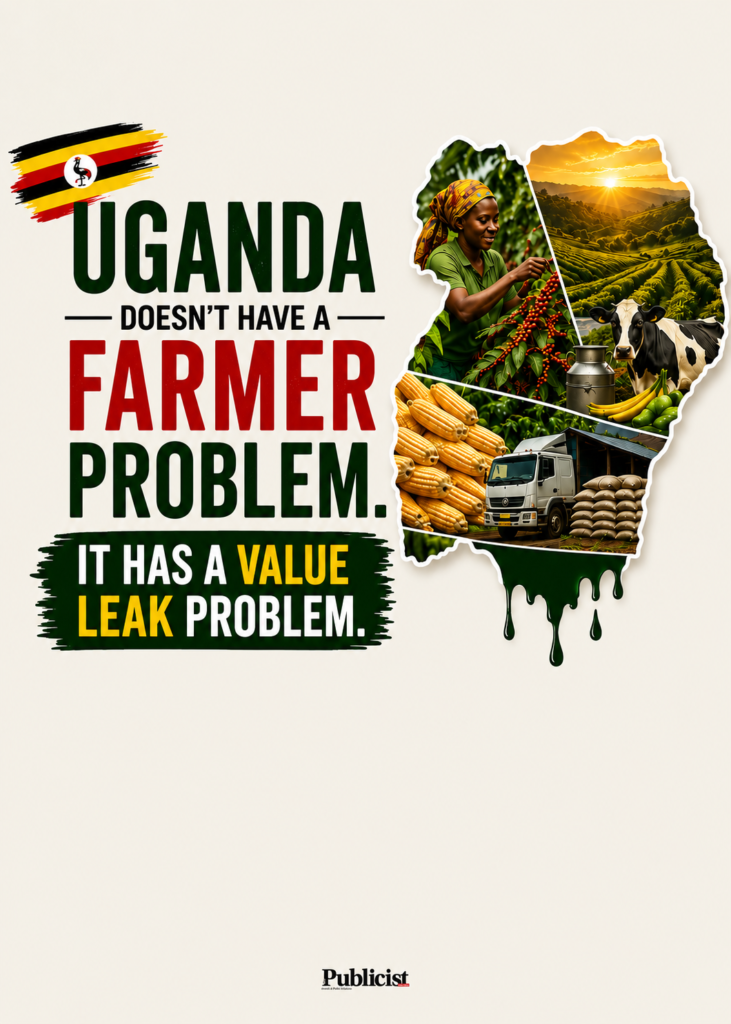
Uganda does not fundamentally suffer from a farmer problem, it suffers from a value leak problem.
Every year, Uganda produces enormous volumes of agricultural output across coffee, maize, dairy, beans, fruits, oil seeds and other commodities. Yet despite this productivity, a significant portion of the value generated within the agricultural chain quietly disappears before it reaches profitable markets.
Not because Ugandans are unwilling to farm, not because the country lacks fertile land, not because agriculture lacks importance, but because too much value leaks between the farm and the market.
The true challenge of Uganda’s agricultural economy often begins after production.
A farmer may harvest successfully, but the next stages of the chain determine whether that produce ultimately creates wealth or simply survives as subsistence activity.
At nearly every stage, inefficiencies quietly erode value through poor post-harvest handling, inadequate storage systems, fragmented aggregation, weak logistics coordination, inconsistent quality standards, volatile pricing systems and limited processing capacity.
By the time produce reaches larger buyers or export markets, both value and margins have already been diluted.
This is why productivity alone cannot transform agriculture.
Without efficient systems connecting farmers to organised markets, increased production sometimes leads to lower incomes rather than greater prosperity.
This structural leakage also explains why many financial institutions remain cautious about agriculture.
Banks are often criticised for not lending aggressively into the sector. Yet from a financing perspective, the concern is understandable.
Agriculture in many cases still operates through fragmented and unpredictable systems characterised by inconsistent supply volumes, poor market coordination, limited collateral structures, climate exposure and weak aggregation systems.
The issue is therefore not simply whether farmers can produce, the issue is whether the broader value chain surrounding production is organised enough to absorb capital sustainably.
This is why many institutions increasingly prefer financing aggregators, processors, storage infrastructure, logistics systems and structured off-take arrangements rather than financing isolated production alone.
One of the least discussed weaknesses in Uganda’s agricultural ecosystem is the “missing middle” between production and markets.
This middle layer includes aggregation systems, storage facilities, transport coordination, processing infrastructure, quality grading systems and market intelligence.
Where these systems are weak, value leakage accelerates.
Farmers are forced to sell quickly after harvest. Prices collapse during peak production periods. Processors struggle with inconsistent supply. Banks struggle to structure financing safely.
The result is an agricultural economy that remains active, but not fully industrialised.
The emergence of initiatives such as National Marketing Company (NAMCo) signals growing recognition that Uganda’s agricultural transformation will require more than production support alone.
Structured aggregation, market coordination and organised purchasing systems are increasingly becoming central to national conversations around agro-industrialisation.
This shift is important because it reframes agriculture not simply as farming, but as a broader economic system involving markets, logistics, finance, processing and industrial coordination.
The future competitiveness of Uganda’s agriculture may therefore depend less on how much is produced, and more on how efficiently value is preserved across the chain.
For decades, agriculture in Uganda has largely been treated as a social sector.
But globally, competitive agricultural economies increasingly operate as industrial systems.
Industrial agriculture depends on predictable supply chains, disciplined aggregation, quality assurance, financing structures, storage and logistics infrastructure and processing capacity.
This is where the next phase of Uganda’s agricultural conversation must move.
From:
“How do we help farmers produce more?”
To:
“How do we build systems that preserve and multiply value?”
Uganda already possesses many of the ingredients required for agricultural transformation, including fertile land, favourable climate, regional market access, a youthful labour force and growing policy interest in agro-industrialisation.
The challenge now is building the systems that connect production to sustainable markets efficiently.
That means reducing value leakage, strengthening aggregation, improving logistics, supporting processing and structuring smarter financing systems.
Agriculture will not transform simply because more people farm.
It will transform when the value chain itself becomes more organised, bankable and industrialised.
And that may ultimately be the real conversation Uganda now needs to have.
The writer is Joseph Kanyamunyu, a Strategic Communications and Public Affairs professional and Managing Director of Publics Africa Communications.