A silent yet profound crisis is unfolding across Uganda and indeed, the globe: millions of people are unable to produce the number of children they desire, not due to a rejection of parenthood, but because of formidable economic and social barriers.
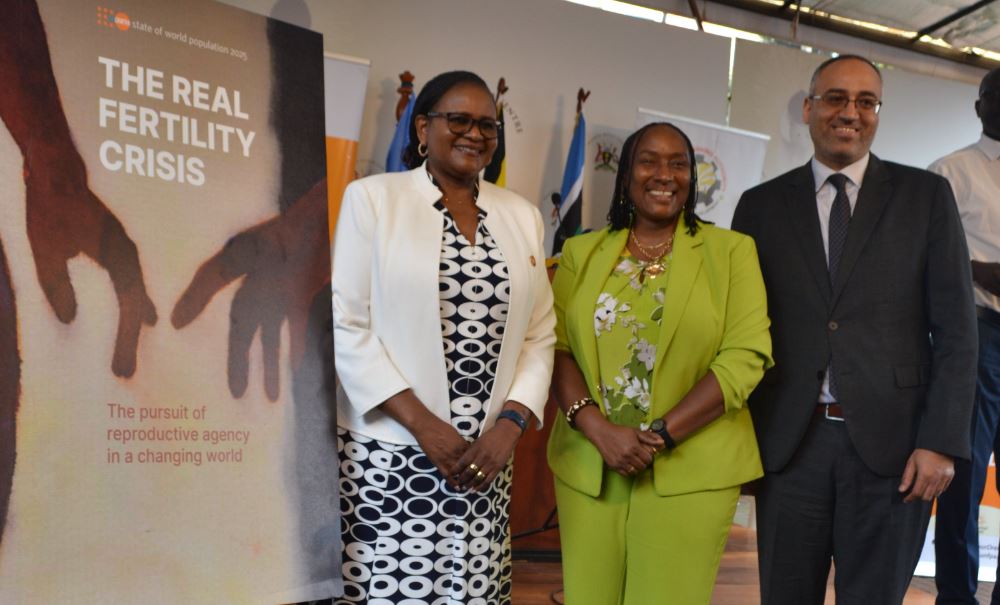
This stark reality forms the central finding of UNFPA’s 2025 State of World Population report, “The real fertility crisis: The pursuit of reproductive agency in a changing world,” officially launched in Uganda today.
First released globally on June 10, 2025, the report states that the genuine fertility crisis is neither overpopulation nor underpopulation, but rather the inability of individuals to realise their desired family goals due to a severe lack of reproductive agency.
This term encompasses a person’s ability to make free and informed choices about sex, contraception, and starting a family if, when, and with whom they want.
Based on academic research and new data from a UNFPA/YouGov survey spanning 14 countries, the report reveals a sobering statistic: one in five people globally expect not to have the number of children they desire due to economic and social barriers, rather than a lack of interest in parenthood.
In Uganda, specifically, a UNFPA-YouGov survey found that 39% of respondents cited financial constraints, particularly childcare costs, as a major obstacle.
“The issue is a lack of choice, not desire, with major consequences for individuals and societies. That is the real fertility crisis, and the solution lies in responding to what people say they need: paid family leave, affordable fertility care, and supportive partners,” emphasised Dr. Gift Malunga, UNFPA Representative in Uganda, at the press launch held at the Uganda Media Centre.
Economic Squeeze is Primary Barrier
The report highlights that over half of global respondents cited economic issues as the primary barriers to having children. This financial burden manifests in various forms, including the rising cost of living, housing, education, and, crucially, affordable childcare.
Even in a country like Uganda, where fertility rates have traditionally been high, economic pressures are leading more Ugandans, especially in urban areas, to delay or choose to have fewer children.
The shift from an agrarian economy, where larger families might provide more labour, to one requiring “hard cash” for school fees, rent, and daily necessities, fundamentally alters family planning decisions.
Other Challenges
Beyond economic constraints, however, the report sheds light on other critical challenges, which include:
Pressure and Unintended Pregnancies
Alarmingly, one in five people globally felt pressured to have children when they did not want to, while one in three adults experienced an unintended pregnancy, underscoring a significant lack of reproductive agency and access to necessary services.
Gender Inequality
The report strongly argues that societal norms and structures that perpetuate gender inequality significantly undermine people’s family choices.
This includes workplace norms that push women out of paid work, the lack of paid flexible leave for men and the stigma against engaged fathers, the absence of affordable childcare, and restrictions in reproductive rights (including access to contraception, abortion, and fertility care).
Diverging gender attitudes between young men and women also contribute to singlehood, further impacting fertility choices.
Call to Action for Governments and Societies
“At UNFPA, we believe that every individual has the right to have the number and spacing of children they desire without coercion or force,” Dr. Malunga asserted. She urged governments to empower people to make reproductive decisions freely through a multi-faceted approach:
Investment in Health and Skills Development:
To improve overall well-being and economic opportunities, Dr. Malunga noted that the government should implement the following;
Roll out supportive policies such as parental leave to enable a better work-life balance for parents.
Increase access to Sexual and Reproductive Health Information and Services (SRHIS) to ensure informed and voluntary reproductive choices, including access to contraception and fertility care.
Provide affordable housing and decent Work to alleviate the financial strain that makes raising children prohibitive for many.
Addressing gender inequality to confront workplace norms that penalise women for motherhood, promoting paid flexible leave for men, destigmatising engaged fathers, and ensuring affordable childcare.
Uganda’s progress in reducing its fertility rate from 6.2 to 4.5 children per woman over the past decade, as cited by the National Planning Authority (NPA), reflects growing access to reproductive health services and education.
However, the UNFPA report serves as a crucial warning against complacency, urging Uganda to safeguard against its fertility falling below the replacement level of 2.1 children, which could pose long-term demographic challenges.
“As policymakers consider how to navigate shifting population dynamics, UNFPA stands ready to support them in understanding the challenges they face and designing solutions that will ensure rights and choices for all,” Dr. Malunga concluded.