On Monday morning in Nairobi, a group of minority shareholders will walk into the Annual General Meeting of WPP Scangroup knowing that the odds are stacked against them.
The mathematics is simple. WPP plc controls a majority stake in the company and can ultimately determine the outcome of any vote. The campaign led by former Scangroup chairman Bharat Thakrar is therefore unlikely to produce an immediate victory, yet the shareholders are showing up anyway.
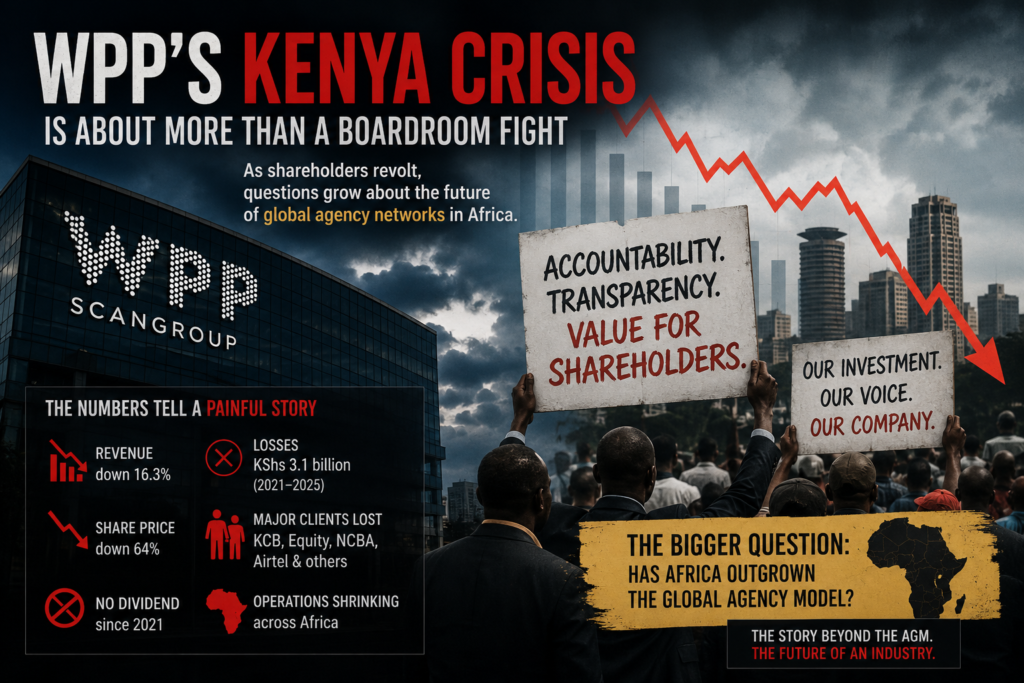
Not because they expect to win, but because they believe the issues they are raising deserve to be formally recorded. For weeks, Thakrar and a growing number of investors have publicly challenged the direction of a company that was once regarded as East Africa’s communications powerhouse. Their concerns center on performance. Revenues have declined, losses have widened, dividends have disappeared and several major clients have departed. Operations that once stretched across multiple African markets have steadily contracted.
The shareholders’ argument is straightforward, a company that once symbolized the ambitions of Africa’s communications industry has lost its strategic direction. Whether one agrees with that assessment or not, the campaign has resonated far beyond the company’s shareholder register.
That is because the debate unfolding around WPP Scangroup reflects a much larger question confronting the communications industry across Africa, what happened to the global agency model?
For decades, affiliation with an international communications network was considered a significant competitive advantage. Global agencies offered multinational clients, international best practices, specialist expertise and access to resources that local firms often struggled to match. In many African markets, the backing of a global parent company was viewed as a mark of credibility and stability.
Today, however, the industry operates under very different conditions. The communications ecosystem has fragmented. Digital platforms have transformed how brands engage audiences. Creator-led media has challenged traditional advertising channels. Specialist advisory firms have emerged in areas such as public affairs, crisis communications and stakeholder engagement. Artificial intelligence (AI) is beginning to reshape content creation, audience analysis and campaign management.
As a result, clients are increasingly evaluating agencies differently. Global scale alone is no longer enough. Organizations are looking for firms that understand local contexts, respond quickly to emerging challenges and deliver measurable outcomes.
In many African markets, some of the most influential communications work is now being led by firms that are deeply embedded in local business, political and social environments. Their advantage is not international reach but proximity to decision-makers, cultural understanding and the ability to navigate increasingly complex local realities.
This shift does not mean global networks have become irrelevant. They continue to offer valuable expertise, international standards and access to multinational business opportunities. But it does suggest that the assumptions that once underpinned their dominance are being challenged.
The WPP Scangroup debate therefore matters because it forces the industry to confront uncomfortable questions about adaptation and relevance.
Can traditional agency structures compete effectively in a market where specialization increasingly matters more than scale? Can multinational networks remain agile enough to respond to rapidly changing client expectations? And how should communications businesses measure success in an era where influence is increasingly decentralized?
There is also an element of irony in the situation. For years, communications agencies have advised corporate leaders on stakeholder engagement, reputation management and shareholder confidence. They have helped organizations navigate public scrutiny and manage difficult conversations about performance and governance.
Today, one of the industry’s most recognizable names finds itself facing those same questions from its own investors. That reality explains why professionals across East Africa are watching the developments in Nairobi so closely.
The AGM vote may determine the immediate future of the company’s board, but it is unlikely to settle the broader debate about the future of the communications industry. Indeed, the outcome of Monday’s vote may already be known, the bigger verdict is still being written.