Uganda’s oil sector has entered its most consequential phase. After more than two decades of exploration, negotiation, and infrastructure development in the Albertine Graben, the country is no longer waiting for oil to be discovered or approved. It is waiting for a complex industrial system to prove it can operate continuously at commercial scale.
Officially, Uganda is approaching first oil. Unofficially, the sector is still navigating the final and most difficult phase of integration, where multiple completed systems must begin working as one, without failure. This is not a construction challenge, it is a convergence challenge.
At the centre of production are the Tilenga and Kingfisher projects, developed by TotalEnergies and the China National Offshore Oil Corporation (CNOOC) respectively. Drilling campaigns have advanced significantly, central processing facilities are largely constructed, and field infrastructure is in place.
However, industry benchmarks are clear on one point, mechanical completion is not the same as production readiness. What is still missing is full commissioning under sustained operational load, where wells, processing facilities, safety systems, and control rooms operate under real production pressure for extended periods without interruption. Uganda sits in the narrow but critical gap between mechanical completion and steady-state operations. This is the phase where major projects experience delays globally, not because infrastructure is incomplete, but because systems fail to stabilise under integrated conditions.
Uganda’s oil reserves in the Albertine Graben were first confirmed in the mid-2000s. Commercial development agreements were finalised in 2021, unlocking final investment decisions for both the upstream fields and the associated export infrastructure.
Since then, land acquisition and compensation processes along the pipeline corridor are reported as largely advanced; upstream drilling and central processing facility construction have progressed substantially; and civil works on the export pipeline are moving toward finalisation.
What remains before first oil can be declared are the commissioning and integration phases, the sustained operational testing described throughout this analysis. No official first oil date has been publicly confirmed at the time of writing, but project-linked sources and parliamentary briefings suggest the sector is within a relatively near-term horizon, contingent on the remaining operational milestones being met.
The most decisive single dependency remains the East African Crude Oil Pipeline (EACOP). Stretching more than 1,443 kilometres to the port of Tanga in Tanzania, the pipeline is not an auxiliary component of the project, it is its commercial lifeline. Without a functioning export route, Uganda’s landlocked oil has no path to market.
Recent public updates from project-linked sources and parliamentary briefings indicate that pipeline construction is highly advanced, and Uganda-side land acquisition and compensation processes are reported as largely completed. These are genuine milestones.
However, as industry analysis, rather than project communications, would suggest, construction progress does not yet equal operational readiness. What remains is end-to-end system commissioning, stabilising the heating systems required to transport Uganda’s waxy crude; testing continuous pumping operations across multiple stations; validating export metering systems; and ensuring seamless cross-border operational coordination between Uganda and Tanzania. These systems must not only function individually. They must operate in synchrony, under sustained flow conditions, across an international boundary.
This is the most important risk window in the entire oil chain: the shift from construction completion to continuous operational proof.
While upstream and midstream infrastructure approaches completion, financing remains a structural pressure point. Uganda’s oil development has attracted billions of dollars in committed investment, but the financing structure of EACOP has been reshaped by ESG-driven withdrawals from several Western financial institutions.
The result is a project increasingly dependent on a narrower pool of financiers, including state-linked entities and regional development partners. To be analytically precise: this does not create a funding gap in the immediate term. But it creates concentration risk, where fewer actors carry greater exposure to cost overruns, operational delays, or tariff disputes once production begins.
This matters because oil infrastructure is not a one-time investment. It requires long-term financial stability for operations, maintenance, insurance, and refinancing across decades. A concentrated financing base increases sensitivity to shocks, particularly in early production years when operational reliability is still being established and revenue flows have yet to be proven at scale.
On the ground, Uganda’s oil corridor is working through the final layers of land and social transition. Compensation processes along the pipeline route and upstream development areas are widely reported as advanced, with completion rates cited as high in public communications.
However, the key analytical distinction, one not always captured in project communications, is between payment completion and livelihood validation. In extractive projects globally, the real test is not whether compensation was paid, but whether affected households achieve sustainable economic recovery after displacement and construction disruption has ended. That verification process is still unfolding in Uganda, and it will matter not only to affected communities but to long-term social licence to operate.
Workforce readiness receives less analytical attention than financing or infrastructure, but it is no less consequential. Large-scale oil production is not primarily a hardware challenge. It is a human systems challenge.
Uganda has made genuine progress in implementing local content policies and training programmes. A significant portion of roles in the upstream development phase have been localised, and sector-specific training pipelines have been established. These are real achievements within a relatively short developmental window.
However, a careful distinction must be drawn between construction-phase participation and operational autonomy. Running a 24-hour production facility, managing reservoir pressure, monitoring pipeline integrity, responding to system fluctuations in real time, requires a depth of operational expertise that takes years to accumulate at scale. Uganda is still in transition from a workforce shaped primarily by construction demands to one capable of sustaining continuous, stable production operations.
This matters for two reasons. First, production stability in the early years depends critically on the quality of decision-making at the operational level. Second, the long-term realisation of local content value, one of Uganda’s core policy objectives, depends on developing indigenous expertise across the full value chain, not only in construction and ancillary services.
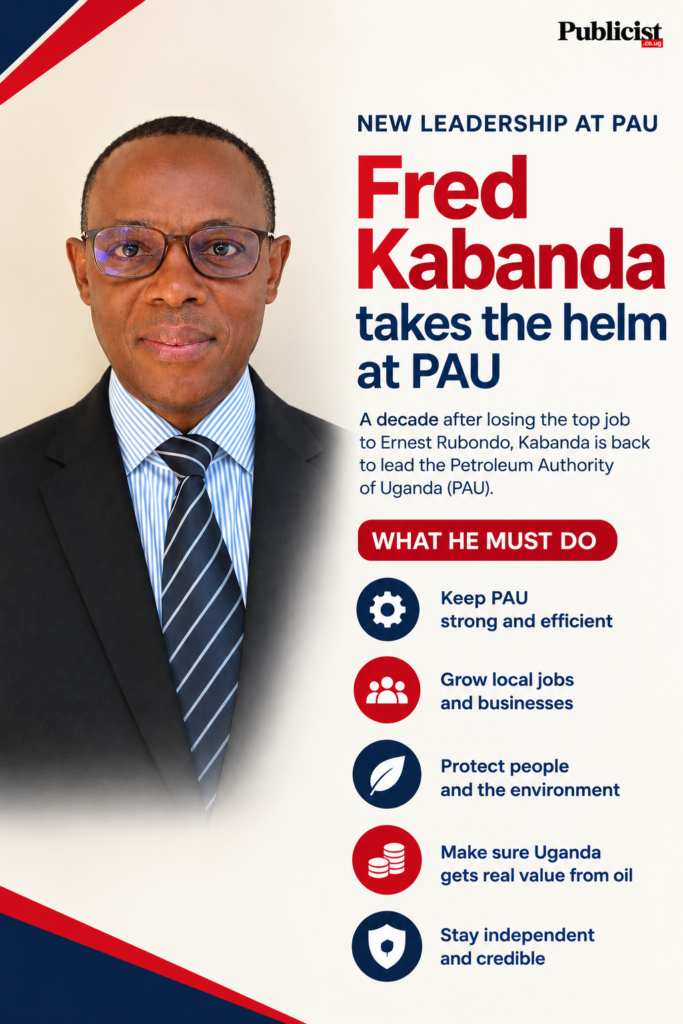
The country’s institutional capacity across the Petroleum Authority of Uganda, the Uganda National Oil Company, and relevant ministries has grown meaningfully over the past decade. Sustaining and deepening that capacity through the operational phase will be as important as any piece of physical infrastructure.
Global market conditions add a further layer of uncertainty that sits outside the control of any project stakeholder. Uganda is preparing to enter oil production at a moment when international energy markets are being reshaped by decarbonisation policies, capital reallocation toward renewables, and long-term demand uncertainty.
Oil remains essential to global supply, and African producers are increasingly positioned as important contributors to meeting near-term demand. But future pricing stability and investment appetite are no longer the guaranteed assumptions they once were for long-cycle projects. Whether Uganda’s oil will be produced within a stable long-term price environment that justifies the scale of investment, or within a more volatile market shaped by energy transition pressures, is a question that shapes the risk calculus for every stakeholder involved.
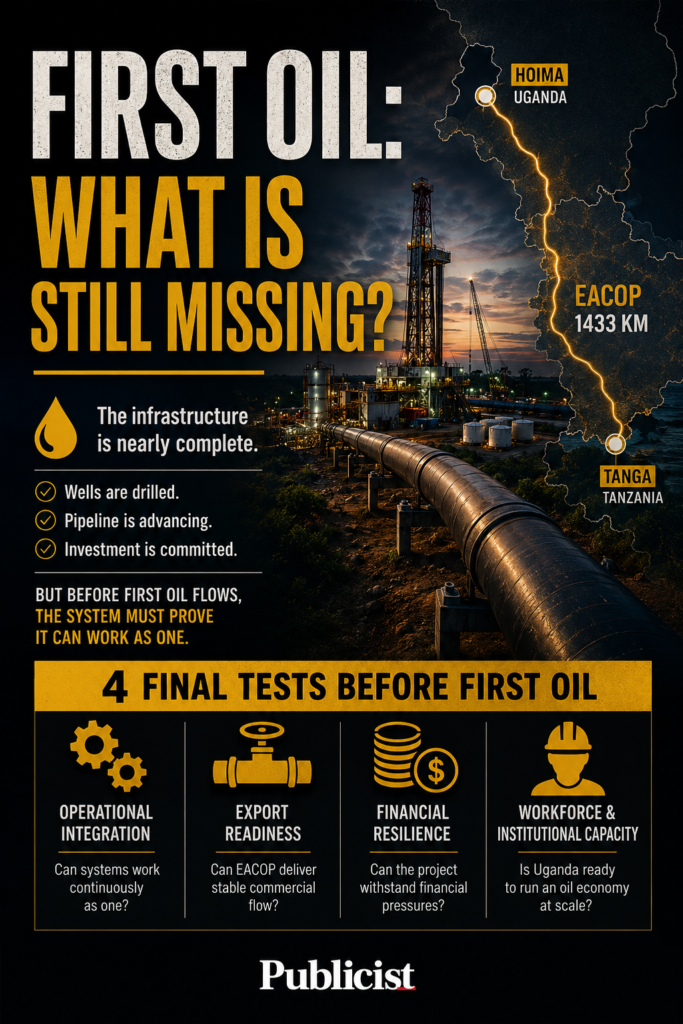
The remaining gaps before first oil group into four interdependent areas:
Operational Integration, whether upstream, processing, and pipeline systems can function continuously as a single, uninterrupted chain under real production conditions.
Export Readiness, whether the EACOP can sustain stable commercial flow across its full 1,443-kilometre length, including waxy crude heating, pump station reliability, and cross-border coordination with Tanzania.
Financial Resilience, whether the narrowed financing base can support long-term operational stability, maintenance, and refinancing across decades.
Workforce and Institutional Depth, whether Uganda’s human systems can sustain continuous production beyond the initial launch phase, and whether regulatory and commercial institutions can deepen specialist capacity across the full operational lifecycle. These four areas are not sequential. They must converge simultaneously.
Uganda’s oil sector is no longer constrained by what has not been built. It is constrained by what has not yet been proven.
It is worth stating plainly what the historical record of large-scale oil development shows, many projects reach physical completion. A smaller number successfully transition into stable, uninterrupted production at commercial scale. The gap between those two outcomes is where reputations, revenues, and long-term sector credibility are determined.
Uganda’s oil system is not missing a project. It is not missing an approval. What it is still building, and what cannot be rushed, is proof. Proof that wells, processing facilities, pipelines, financing structures, trained workforces, and institutional systems can operate not just at launch, but continuously, across years and decades.In the oil industry, that is the final threshold. And it is the one that matters most.