Uganda’s banks are posting record profits, but the productive economy is still struggling to access credit. The gap is not a shortage of money. It is a system that converts liquidity into safe returns faster than it converts enterprise into bankable risk.
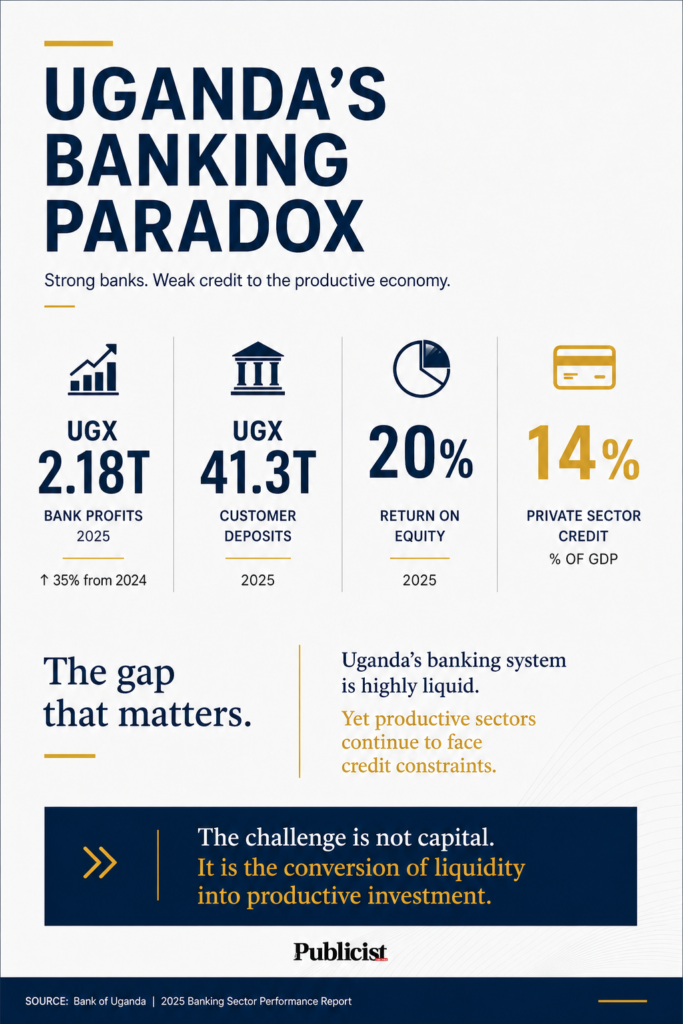
In 2025, Uganda’s 22 commercial banks earned UGX 2.18 trillion in net profit, up 35 percent from UGX 1.61 trillion in 2024. Assets rose to UGX 61.5 trillion, deposits to UGX 41.3 trillion, and return on equity reached 20 percent. Yet credit to the private sector grew by only about 10 percent, well below the pace of balance sheet expansion. The system is liquid, but selective.
Domestic credit to the private sector remains around 14 percent of GDP, compared to a global average of roughly 52 percent. The constraint is not capital availability. It is how capital is allocated.
Bank lending is governed by capital adequacy rules, internal risk models, and shareholder expectations that reward stability over experimentation. In that environment, government securities offer high, risk-free returns, large corporates are easier to underwrite, and salaried borrowers are easier to score. Capital naturally flows toward what is easiest to price, not what is most transformative for development.
On the public finance side, domestic debt instruments set the risk-free benchmark for the entire financial system. When government securities are both liquid and attractive, they compete directly with private sector lending for the same pool of deposits. The result is not crowding out in a simplistic sense, but a structural re-pricing of risk across the economy in favor of safety.
On the demand side, much of the productive economy is not structured in a form that aligns with bank credit models. SMEs often lack audited financial statements or stable cash flows. Agriculture, despite contributing roughly a quarter of GDP, remains exposed to seasonal volatility, weak insurance systems, and informal land tenure. Emerging sectors rely on intangible assets that traditional collateral frameworks do not recognize.
This creates a persistent mismatch: the sectors most important for structural transformation are also the least legible to formal credit systems.
Agriculture receives only about 11–13 percent of private credit, often at interest rates above 20 percent and on short tenors that do not match production cycles. The “missing middle”, firms too large for microfinance but too informal or small for commercial bank lending, remains the most constrained segment of the economy.
Banks argue that lending is constrained by structural risk: weak enforcement of contracts, slow collateral recovery, and limited credit information. From this perspective, the priority is not to expand credit into risky sectors, but to wait until enterprises become bankable.
But this reveals the central tension in development finance: economies cannot industrialize only after they become low-risk. Risk has to be financed before it is fully resolved.
High borrowing costs do more than slow credit expansion. They shape the structure of the economy itself, reinforcing consumption over production, short-term trade over long-term investment, and limiting industrial scaling.
There are early signs of gradual movement. Private sector credit grew for two consecutive months into April 2026, rising 1.8 percent, alongside GDP growth of 6.4 percent. But the key question is not whether credit is growing, it is where it is flowing, and whether it is reaching firms capable of driving productivity gains.
A banking system should not be judged solely by profitability. Its deeper test is whether it can consistently convert liquidity into productive investment: factories, modern agriculture, export capacity, and scalable SMEs.
Bridging this gap requires more than marginal adjustments in interest rates. It requires structural changes in how risk is absorbed and priced across the financial system. Credit guarantees, stronger credit registries, agricultural insurance, deeper capital markets, and lending models that recognize non-traditional forms of collateral all become necessary instruments.
Ultimately, Uganda’s constraint is not the availability of capital. It is the conversion of economic activity into financial risk that banks can safely underwrite.
Until that changes, the paradox will remain intact: banks will continue to thrive, while the productive economy continues to wait.