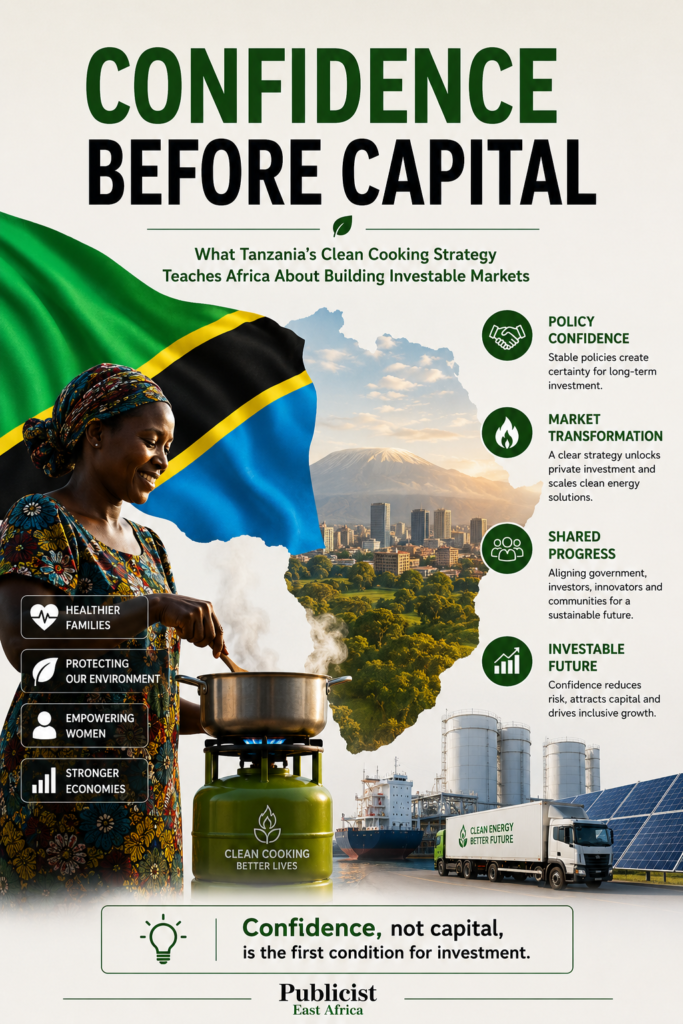
By Publicist East Africa
Investors rarely fear bad markets; they fear uncertain ones. That distinction explains far more about investment patterns across Africa than many policy debates acknowledge.
Across much of the continent, the greatest constraint is rarely the absence of demand or capital. It is the unpredictability of the environment in which capital must commit for the long term.
For years, Tanzania’s dependence on firewood and charcoal was viewed primarily through the lenses of public health and environmental sustainability. Most households relied on biomass for cooking, indoor air pollution contributed to widespread respiratory illness, and forests continued to shrink under pressure from charcoal production.
Yet what initially appeared to be an energy transition challenge has evolved into something far more significant. Tanzania’s response offers an important lesson in market development, one that extends well beyond clean cooking.
At its core, the country’s National Clean Cooking Strategy 2024–2034 is not simply about changing how households cook. It is about reducing one of the most decisive variables in investment decisions: uncertainty.
Private capital does not move simply because opportunity exists. It moves when investors believe that opportunity will remain stable long enough to generate sustainable returns. Investment, therefore, begins not with capital, but with confidence.
That lesson carries important implications for governments across Africa.
Too often, conversations about attracting investment revolve around tax incentives, concessional finance, investment conferences and promotional campaigns. While these tools have their place, they frequently overlook a more fundamental reality: investors are ultimately committing to the future, not merely responding to present-day opportunities.
Markets become investable when participants believe the rules of the game will remain sufficiently predictable over time. Tanzania’s clean cooking strategy represents precisely that kind of long-term market signal.
Rather than functioning solely as an energy policy, the strategy establishes a ten-year framework that aligns expectations across households, private companies, financiers, development institutions and government agencies. By committing to universal access to clean cooking by 2034 and identifying Liquefied Petroleum Gas (LPG), electricity and other modern fuels as central to that transition, the government has provided something markets value immensely, a credible direction of travel.
This matters because emerging markets often struggle less with demand than with coordination.
For decades, Tanzania’s clean cooking market reflected a classic coordination failure. Households wanted cleaner and more affordable alternatives to charcoal, yet private companies hesitated to invest heavily in LPG infrastructure because future demand remained uncertain. Banks were reluctant to finance import terminals, storage facilities and distribution networks without evidence of scale. The government sought greater private sector participation, while the private sector waited for stronger policy certainty.
Everyone waited for someone else to move first. This pattern is hardly unique to Tanzania. Similar dynamics continue to shape investment across Africa’s energy, housing, transport, agriculture and manufacturing sectors, where fragmented demand exists but fails to consolidate into investable markets.
Breaking such cycles requires more than additional financing. It requires credible policy signals that reduce uncertainty sufficiently for multiple actors to move simultaneously.
That is precisely where Tanzania’s strategy becomes economically significant.
Large infrastructure investments are rarely based on today’s consumption levels alone. Import terminals, bottling plants, storage depots and nationwide distribution networks are assets designed to operate over decades. Investors therefore evaluate not only current demand, but also the likelihood that government policy will remain sufficiently consistent to support long-term market growth.
When that confidence exists, capital becomes easier to mobilise and the cost of financing falls.
Early market indicators suggest that Tanzania is entering precisely such a phase.
The country’s LPG sector is now valued at more than US$1 billion. Imports increased from approximately 293,000 metric tonnes in 2023 to more than 403,000 metric tonnes in 2024. Yet annual per capita consumption remains only about 2.6 kilograms, well below the government’s target of 10 kilograms by 2033.
Rather than signalling market weakness, this gap highlights how early the sector remains in its expansion. For investors, it represents considerable room for long-term growth.
Policy certainty alone, however, cannot transform markets unless consumers are also able to participate.
Historically, affordability, not awareness, has been the principal barrier to wider LPG adoption. Many households understand the health, environmental and economic benefits of cleaner fuels but struggle to afford the upfront cost of a full cylinder refill.
Here, technological innovation is proving just as important as policy.
Pay-As-You-Go LPG systems, enabled by East Africa’s extensive mobile money ecosystem, allow households to purchase fuel in smaller, incremental amounts rather than making large one-off payments. While this appears to be a simple payment innovation, its economic significance is much broader.
By lowering entry barriers, Pay-As-You-Go models expand the addressable customer base, generate valuable transaction histories that improve credit assessment, and produce verified usage data that supports carbon finance programmes. In doing so, they reduce commercial risk while making the sector increasingly attractive to institutional investors seeking scalable, measurable opportunities.
As these developments converge, an uncommon alignment begins to emerge.
Governments pursue improved public health, reduced deforestation and expanded energy access. Private investors seek predictable returns. Development finance institutions prioritise measurable social impact. Climate finance rewards verified emissions reductions.
In many sectors, these objectives compete with one another. In clean cooking, they increasingly reinforce one another. Regulation also plays a far more constructive role than it is often given credit for.
Across many African economies, regulation is frequently portrayed as an obstacle to business. Yet well-designed regulatory frameworks function as economic infrastructure. Licensing systems, safety standards, certification requirements and quality assurance mechanisms reduce risk, increase market trust and lower the uncertainty premium that often inflates the cost of capital in emerging markets.
For banks and institutional investors, predictable regulation frequently matters just as much as commercial opportunity.
Viewed through this broader lens, Tanzania’s National Clean Cooking Strategy becomes more than an energy transition framework. It offers a practical demonstration of how governments build investable markets, not by replacing private capital, but by creating the conditions under which private capital is willing to commit.
The implications extend well beyond LPG.
Across East Africa, governments are pursuing ambitious agendas in industrialisation, affordable housing, transport infrastructure, renewable energy, agriculture and climate resilience. Financing these ambitions will require far more than public expenditure or development assistance. It will require creating policy environments that allow markets to coordinate around a shared long-term direction.
The first challenge, therefore, is not mobilising more capital. Global capital has never been in short supply. The more difficult task is creating markets where investors believe today’s policy commitments will still exist tomorrow. That is ultimately what confidence means.
Capital is highly mobile and constantly searches for attractive opportunities. But it commits deeply only where uncertainty is managed, institutions are credible and long-term expectations are sufficiently stable to justify investments measured not in months, but in decades.
Tanzania’s National Clean Cooking Strategy demonstrates that markets are not external forces waiting to be discovered. They are institutional outcomes shaped by deliberate policy choices that either reduce or amplify uncertainty.
Its success should therefore be measured not only by fewer households relying on charcoal, higher LPG consumption or healthier communities, important though those outcomes undoubtedly are. Its broader significance lies in demonstrating that governments create investable markets by building confidence first.
For African policymakers seeking to accelerate industrialisation, infrastructure development and private investment, that may be the most valuable lesson of all.Confidence, not capital, is the first condition for investment.