
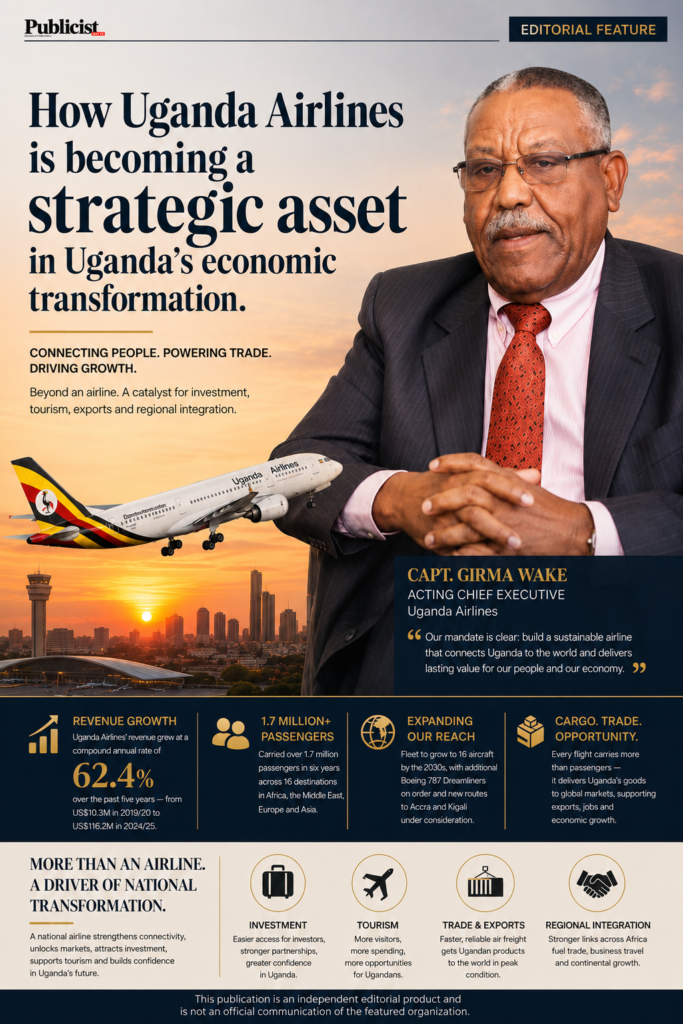
Uganda Airlines‘ revenue grew at a compound annual rate of 62.4 percent over the past five years, according to the Ministry of Works and Transport, climbing from US$10.3 million in the 2019/20 financial year to US$116.2 million in 2024/25. The airline is also still losing money: the Auditor General’s report for 2024/25 put the net loss at roughly UGX 230.8 billion, or about US$65 million, barely improved on the previous year’s figure. Both of those facts are true at once, and the more interesting question is which one should actually shape how we judge the airline.
In February 2026, President Museveni removed then-CEO Jenifer Bamuturaki amid parliamentary scrutiny over losses and management weaknesses, and installed the veteran aviation executive Girma Wake, best known for building Ethiopian Airlines into one of the continent’s strongest carriers, as consultant and acting chief executive, with a mandate to stabilise the airline and help recruit a substantive successor
A flight schedule can shape an economy just as much as a highway, a railway or a power station. Every direct international route determines how easily investors reach a country, how quickly exporters access global markets, how confidently tourists plan their holidays and how efficiently businesses connect with partners across continents. In today’s economy, aviation is no longer simply about moving people from one destination to another. It has become a strategic enabler of trade, tourism, investment and economic competitiveness.
For years, the conversation around Uganda Airlines revolved almost entirely around aircraft acquisitions, taxpayer funding, operating losses and whether the country needed a national carrier at all. Those debates were understandable. Reviving a national airline required significant public investment at a time when many questioned whether the returns would justify the cost, and the losses have been real: since its 2019 relaunch, the airline has accumulated hundreds of billions of shillings in deficits.
Yet recent developments suggest the terms of that debate are beginning to shift, even if the losses haven’t disappeared.
Alongside its revenue growth, Uganda Airlines carried more than 1.7 million passengers over the past six years while expanding its network to 16 destinations across Africa, the Middle East, Europe and Asia. The Ministry has also indicated that the airline intends to expand its fleet to 16 aircraft by the 2030s, with additional Boeing 787 Dreamliners on order and new routes to Accra and Kigali under consideration.
These figures are significant, not because they suggest Uganda Airlines has overcome every commercial challenge, it clearly has not, but because they point to a national institution becoming increasingly relevant to the wider economy, even as it works through its financial and governance problems.
Around the world, countries no longer compete solely through tax incentives, industrial parks or abundant natural resources. They compete through connectivity. The ease with which investors can reach a capital city, exporters can access overseas markets and tourists can arrive at a destination increasingly influences economic performance. Connectivity reduces the cost of doing business, encourages investment and strengthens a country’s integration into regional and global value chains.
This is why governments continue to invest heavily in aviation infrastructure. Every additional direct flight reduces friction between economies. It shortens travel times, lowers transaction costs and creates new opportunities for commerce. A route map is therefore more than a collection of destinations; it is a map of economic relationships.
Uganda Airlines’ direct service to London illustrates this broader role. The route is far more than another destination on the airline’s timetable. The United Kingdom remains one of Uganda’s important tourism and investment markets and is home to a large Ugandan diaspora. Direct connectivity strengthens business relationships, facilitates diplomatic engagement and improves investor confidence by making Uganda more accessible. For tour operators, it enhances Uganda’s competitiveness as a destination. For businesses, it reduces the time and uncertainty associated with international travel. In effect, the route creates an economic corridor rather than simply an air connection.
Perhaps the least appreciated contribution of a national airline lies beneath the passenger cabin. Every long-haul aircraft also carries cargo, providing exporters with valuable access to international markets. Uganda’s coffee, fresh flowers, fish, pharmaceuticals and other high-value, time-sensitive products depend on reliable air freight to reach overseas buyers in good condition. Faster delivery improves product quality, reduces spoilage and allows exporters to compete more effectively in demanding global markets. The value of an airline therefore extends well beyond passenger tickets; it also supports the movement of commerce.
The benefits extend even further. Tourism begins with accessibility. Even the world’s most attractive destinations struggle to compete if reaching them is difficult or expensive. Direct air links simplify travel planning, increase visitor confidence and expand opportunities for hotels, tour operators, transport companies, restaurants and countless small businesses that depend on visitor spending. Every arriving aircraft generates economic activity that reaches far beyond the airport itself.
The same principle applies to regional integration. As the African Continental Free Trade Area reshapes commerce across the continent, efficient air connectivity between African cities will become increasingly important. Planned routes to Accra and Kigali should therefore be viewed not simply as commercial expansion but as investments in stronger regional trade, business travel and investment flows. For a landlocked country such as Uganda, aviation helps overcome geography by reducing the economic cost of distance.
International experience reinforces this point. Ethiopian Airlines has played a central role in establishing Addis Ababa as one of Africa’s leading aviation hubs, supporting tourism, logistics and trade. Emirates helped transform Dubai into a global centre for commerce and international travel, while Singapore Airlines complemented Singapore’s emergence as one of the world’s most connected business destinations. Uganda is operating on a different scale, but the underlying lesson remains relevant: when managed strategically, a national airline can become an instrument of economic development rather than simply a transport company.
None of this suggests that Uganda Airlines’ future success should be taken for granted. Revenue growth should not be confused with profitability, and the numbers make that plain: a US$65 million annual loss is not a rounding error, and trade payables have continued to climb alongside it. Commercial aviation remains one of the world’s most capital-intensive and competitive industries, with airlines constantly exposed to volatile fuel prices, exchange rate fluctuations, aircraft financing costs and intense regional competition. Sustainable growth will depend on strong corporate governance, disciplined financial management, operational efficiency and sound commercial decision-making.
Governance, in particular, has been a live issue rather than a footnote. In February 2026, President Museveni removed then-CEO Jenifer Bamuturaki amid parliamentary scrutiny over losses and management weaknesses, and installed the veteran aviation executive Girma Wake, best known for building Ethiopian Airlines into one of the continent’s strongest carriers, as consultant and acting chief executive, with a mandate to stabilise the airline and help recruit a substantive successor. The move drew criticism from governance analysts who questioned a presidential directive bypassing the airline’s own board, even as many welcomed Wake’s operational credentials. Wake’s acting mandate runs only to July 2026, which means Uganda Airlines is, right now, in the middle of choosing the leadership that will determine whether its recent momentum becomes durable or simply a good few years sandwiched between crises.
Nor can Uganda Airlines transform the economy in isolation. Its success is closely linked to the efficiency of Entebbe International Airport, modern cargo handling facilities, streamlined customs procedures, tourism infrastructure and a broader logistics ecosystem that enables people and goods to move efficiently. Economic transformation is rarely the product of a single institution; it emerges when complementary systems reinforce one another.
For much of its existence, Uganda Airlines was judged primarily by what it cost. Increasingly, it should also be judged by what it enables, without pretending the cost has gone away. Every aircraft that departs Entebbe carries more than passengers. It carries investors exploring opportunities, entrepreneurs building partnerships, tourists discovering Uganda, exporters reaching international markets and businesses strengthening connections with the rest of the world.
History rarely remembers airlines for the number of aircraft they owned or the passengers they carried. It remembers the opportunities they created, and, just as often, the mismanagement that squandered them. If Uganda Airlines can convert its commercial momentum into disciplined, well-governed growth under whichever leadership takes over from Wake, its greatest contribution may not be measured in annual revenue, or even in annual losses, but in the investment it attracts, the exports it facilitates, the tourism it supports and the confidence it gives the world in Uganda as a place to trade, invest and grow. That is what would distinguish a transport company from a strategic national asset, and it is still an open question, not a settled one.