With aggregation, farmers become suppliers. They gain access to larger markets, better market information, improved inputs and stronger bargaining power. Businesses, in turn, gain what they need most: reliable, predictable supply. Modern agricultural markets are no longer built simply on the ability to grow crops. They are built on the ability to consistently deliver the right quantity, at the right quality and at the right time.
Uganda’s agricultural challenge has never been a shortage of farmers. Across the country, millions of households grow coffee, maize, beans, fruits, vegetables and livestock products. The country enjoys some of the most favourable agricultural conditions on the continent, supported by fertile soils, diverse ecosystems and generations of farming knowledge.
Yet agriculture continues to deliver less economic value than its potential suggests. Farmers often struggle with low incomes. Processors struggle to secure reliable supplies. Exporters struggle to meet quality and volume requirements. Consumers experience unpredictable prices. Uganda produces, but the system connecting production to markets remains fragmented.
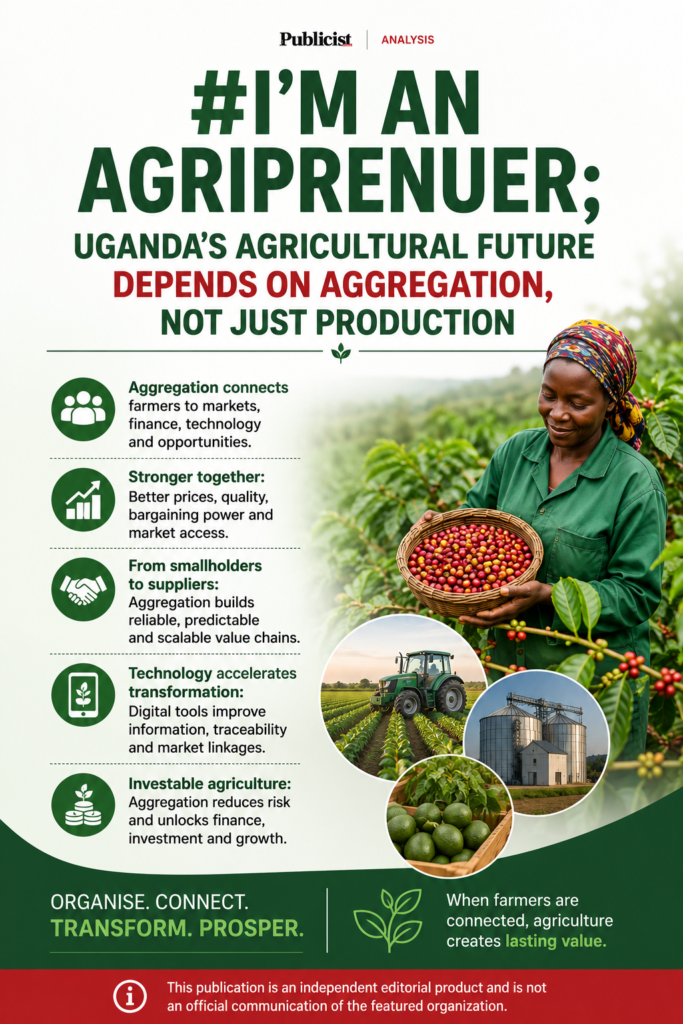
The missing piece is not production. It is organisation. Uganda’s agricultural future depends on solving one fundamental challenge: how to transform millions of smallholder farmers producing individually into a commercially connected network capable of supplying modern markets. That is the role of aggregation.
Agriculture becomes a business when farmers are no longer viewed as isolated producers but as participants in organised value chains that connect production, finance, technology, logistics and markets. Without aggregation, a farmer remains vulnerable to whoever arrives at the farm gate with cash. They sell small quantities, negotiate from a weak position and often have little influence over pricing or market decisions.
With aggregation, farmers become suppliers. They gain access to larger markets, better market information, improved inputs and stronger bargaining power. Businesses, in turn, gain what they need most: reliable, predictable supply. Modern agricultural markets are no longer built simply on the ability to grow crops. They are built on the ability to consistently deliver the right quantity, at the right quality and at the right time.
This is where Uganda’s agricultural transformation challenge lies. For decades, policy has largely focused on increasing production. While this has expanded output in several commodities, production alone does not create prosperous agricultural economies. Countries that have successfully transformed agriculture did so by building institutions, companies and market systems that connected farmers to value chains.
They did not simply encourage farmers to produce more. They helped them produce for markets. Uganda’s fragmented agricultural structure makes this difficult. Most farmers operate on a small scale, producing independently and making decisions based on immediate household needs rather than reliable market signals. Meanwhile, processors, supermarkets, exporters and institutional buyers require consistent volumes, standardised quality and dependable delivery schedules.
The result is a market where everyone participates, but few capture maximum value.
Farmers produce, but struggle to access premium markets. Traders connect buyers and sellers, but often operate through short-term transactions. Processors need raw materials but cannot always guarantee supply. Consumers ultimately bear the cost of inefficiencies throughout the value chain.
Aggregation provides the coordination mechanism that brings these actors together.
A successful aggregator does far more than collect produce. It creates an organised relationship between farmers and markets. It helps farmers plan production based on demand, improves quality standards, reduces post-harvest losses and provides a structure through which financial institutions, insurers and investors can confidently participate.
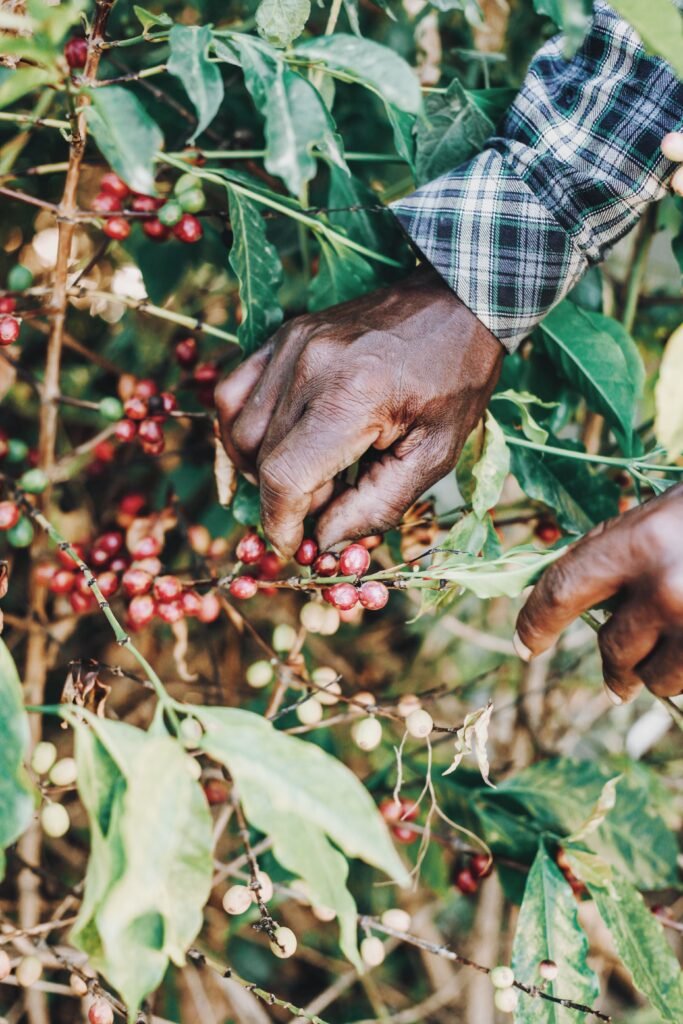
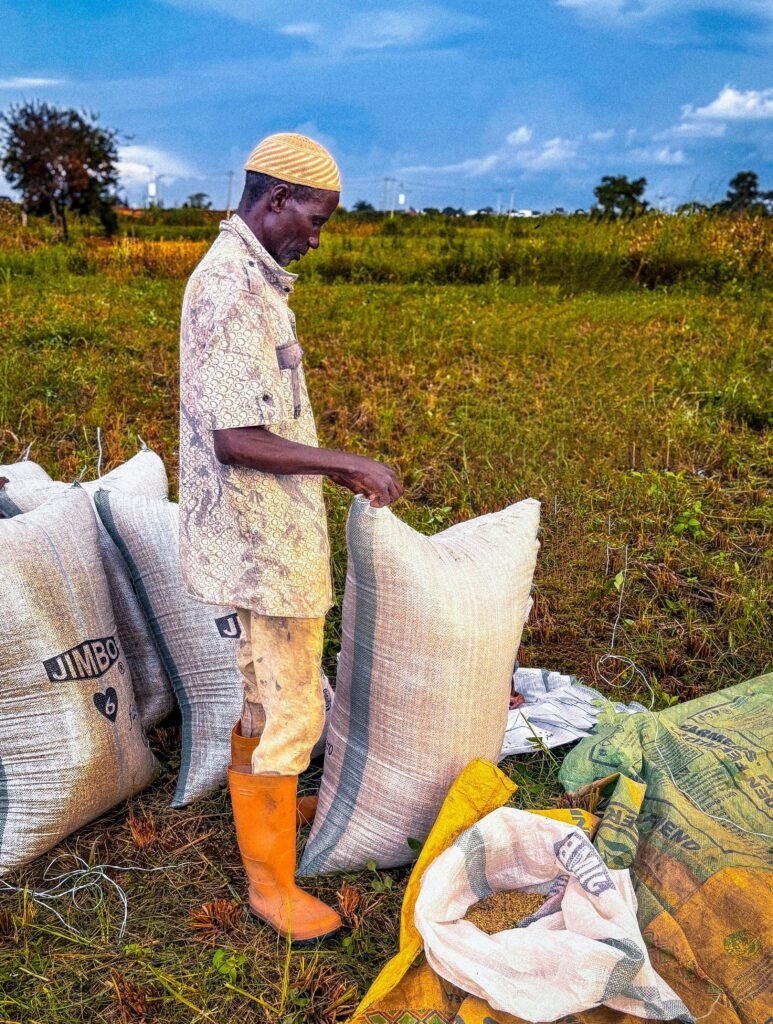
Uganda already offers examples of what this can look like. In the coffee sector, organised cooperatives and farmer organisations have enabled smallholders to bulk coffee, improve quality through better post-harvest handling, negotiate stronger prices and access export markets that would be difficult to reach individually. In grain-producing regions, aggregation centres have helped reduce post-harvest losses while supplying millers and institutional buyers with more consistent volumes.
These examples demonstrate that value is created not simply by producing more, but by organising production more effectively. Aggregation also changes how investors view agriculture.
One of the biggest barriers to agricultural finance is fragmentation. Financing thousands of individual farmers is expensive, difficult to monitor and carries significant risk. Aggregation reduces these challenges by creating organised, scalable and financeable value chains. Instead of financing isolated producers, banks, impact investors and agribusinesses can invest through structured farmer groups, cooperatives, contract farming arrangements or aggregation platforms with clearer production data, stronger governance and more predictable cash flows.
In other words, aggregation converts agriculture from a collection of dispersed small enterprises into an investable economic sector. This is particularly important in coffee, where Uganda has demonstrated remarkable production potential but still captures only a modest share of the value created across the global value chain.
The greatest value in coffee does not come from growing cherries alone. It comes from processing, branding, certification, roasting, packaging and direct access to premium consumers. Participation in these markets increasingly depends on meeting stringent quality standards, ensuring traceability from farm to buyer and complying with sustainability certifications demanded by international markets.
Aggregation gives farmers the scale, organisation and management systems needed to meet these requirements while opening opportunities to participate in higher-value segments of the industry. The same principle applies to dairy, horticulture, grains and livestock. The challenge is not simply whether Uganda can produce. It is whether production can be organised into commercially competitive systems.
Technology now offers an opportunity to accelerate this transition. Digital platforms can connect farmers with buyers, track production, provide market intelligence, facilitate payments and improve transparency across supply chains. Digital records can also strengthen traceability, allowing exporters and processors to verify product origins and compliance with market standards. Just as mobile money transformed financial inclusion, agricultural technology can transform how farmers participate in modern markets.
The farmer of the future should not operate alone. They should be connected to an ecosystem where information, finance, logistics and markets move as efficiently as the products they produce.
Building that ecosystem cannot be left to farmers alone. It requires stronger private sector participation from agribusinesses, processors, financial institutions, logistics companies and technology firms, supported by policies that encourage investment in market infrastructure rather than production alone.
The next agricultural breakthrough will not come simply from distributing more seeds, fertiliser or farming advice. It will come from building commercially sustainable systems that allow farmers to participate in larger economic networks.
A farmer growing coffee, maize or vegetables should not be viewed merely as a beneficiary of agricultural programmes. They should be recognised as a business partner, supplier and entrepreneur within an integrated value chain.
Uganda does not lack farmers. Uganda does not lack markets. The missing infrastructure is the connection between the two. Aggregation is that connection. The country’s agricultural transformation will not ultimately be measured by how much it produces, but by how effectively it converts production into income, investment, industrial growth and globally competitive value chains.
Because agriculture creates prosperity not simply when crops grow, but when farmers are connected to markets that reward quality, consistency and value. The question Uganda must now answer is no longer only: How do we produce more?
The more important question is: How do we organise what we already produce into an agricultural economy that works for farmers, businesses, investors and consumers? The answer begins with aggregation.
Editor’s Note: This article is part of the I Am An Agripreneur thought leadership series by Publicist East Africa, exploring the ideas, policies, market innovations and investment opportunities shaping the future of agriculture, agribusiness and industrialisation across East Africa. We welcome diverse perspectives, evidence-based debate and contributions from farmers, entrepreneurs, policymakers, researchers, investors and development practitioners. To share your insights, submit an article or join the conversation, write to yourstory@publicisteastafrica.com.