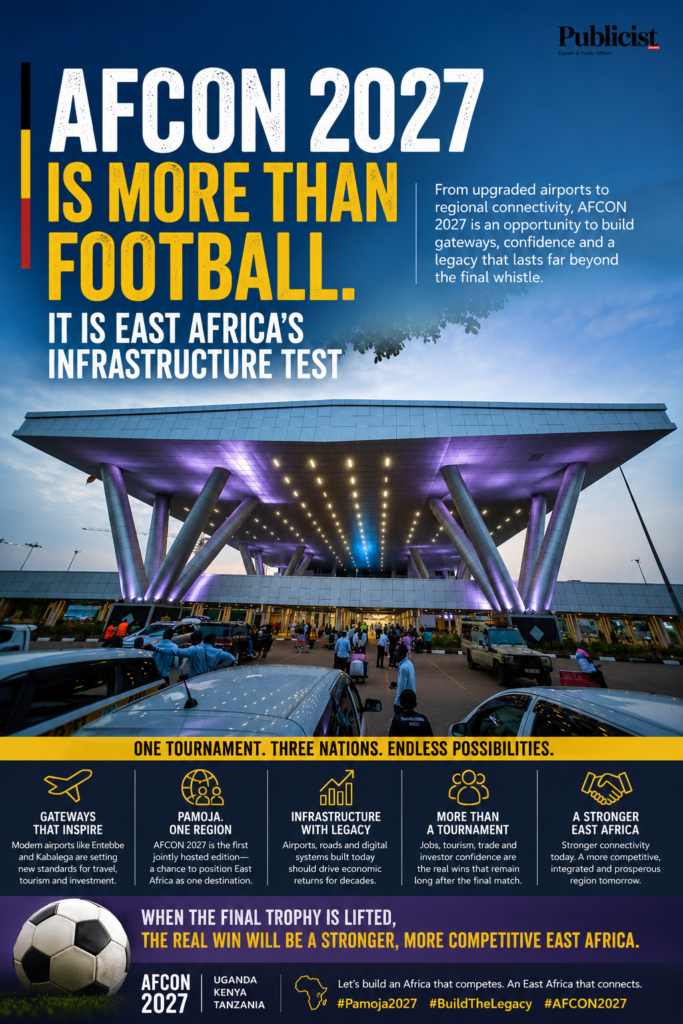
When Uganda, Kenya and Tanzania secured the right to jointly host the 2027 Africa Cup of Nations under the “Pamoja” (Together) bid, the headlines naturally focused on football. Yet with less than a year before the continent’s biggest sporting spectacle kicks off, the tournament is increasingly becoming a test of something much larger than sport. It is a test of East Africa’s ability to deliver world-class infrastructure, seamless logistics, regional integration and a lasting economic legacy.
“Preparedness for AFCON, chair, I want to confirm that Entebbe International Airport which is the gateway, will be ready for AFCON. The new terminal building will be ready,” Lumonya told MPs.
For Uganda, that first impression will not be made inside Mandela National Stadium. It will begin at Entebbe International Airport, where thousands of players, officials, journalists, sponsors, investors and supporters are expected to arrive. Before they experience Uganda’s hospitality, tourism attractions or business opportunities, they will experience its aviation gateway.
Recognising this, the Uganda Civil Aviation Authority (UCAA) has assured Parliament that the country’s principal airport will be fully prepared before the tournament begins.
Appearing before the Parliamentary Committee, UCAA Deputy Director General Olive Lumonya sought to reassure legislators that airport infrastructure would not become a weak link in Uganda’s AFCON preparations.
“Preparedness for AFCON, chair, I want to confirm that Entebbe International Airport which is the gateway, will be ready for AFCON. The new terminal building will be ready,” Lumonya told MPs.
Her assurance reflects a growing recognition that modern sporting events are judged by far more than what happens inside stadiums. Visitors begin forming opinions about a country the moment they land. Immigration efficiency, passenger experience, digital services, baggage handling and airport operations increasingly shape perceptions of national competence long before visitors check into hotels or attend football matches.
In today’s global economy, airports have evolved into symbols of national competitiveness. They are no longer merely transport facilities but strategic economic infrastructure that influences tourism, trade, investment and international business. For countries seeking to attract investors and position themselves as regional hubs, the quality of an airport often communicates as much about national ambition as government policy or investment incentives.
The upgrades underway at Entebbe appear designed with that broader objective in mind.
“We have 24 counters at the new terminal building, we have self-check-in counters, we have three bridges, so the image and speed and operation efficiency when we are receiving the delegates for AFCON through Entebbe International Airport will be ready,” Lumonya said.
These improvements extend beyond aesthetics. Additional check-in counters increase passenger processing capacity, self-service technology reduces congestion, while passenger boarding bridges improve operational efficiency and passenger convenience. For a tournament expected to attract tens of thousands of international visitors, such investments could significantly reduce the bottlenecks that have historically characterised peak travel periods at Uganda’s busiest airport.
Yet the more important question is not whether Entebbe will be ready for AFCON. It is whether AFCON will leave Uganda better prepared for the decades that follow.
History shows that major sporting tournaments rarely transform economies on their own. Their greatest value lies in providing governments with a fixed deadline to accelerate infrastructure, strengthen institutions and build investor confidence. Airports, highways, digital systems and tourism assets continue generating economic returns long after the final whistle. The true legacy of AFCON 2027 will therefore be measured less by the football played than by the competitiveness East Africa creates.
That is particularly significant because AFCON 2027 is unlike any previous edition of the tournament. It is the first to be jointly hosted by three East African nations. The “Pamoja” bid represents more than shared stadiums and fixtures. It offers an opportunity to position East Africa as a connected tourism and investment destination where visitors can move more easily across borders, explore multiple countries and experience the region as a single economic bloc.
If managed effectively, the tournament could strengthen aviation links, stimulate cross-border tourism, encourage regional business travel and reinforce the East African Community’s broader ambitions for economic integration. The infrastructure being developed today could become part of a much larger regional growth story tomorrow.
Uganda is also expanding that vision beyond Entebbe.
Lumonya informed Parliament that Kabalega International Airport is substantially complete, with only its passenger terminal building remaining before full passenger operations commence.
“The second one is Kabalega which is also ready, waiting for the passenger terminal building. So, on AFCON, I want to confirm that we are ready to receive the guests,” she said.
Kabalega International Airport represents more than additional aviation capacity. Located in the Albertine region, it supports one of Uganda’s fastest-growing economic corridors driven by oil and gas development, industrial investment and expanding logistics networks. Together, Entebbe and Kabalega signal broader ambitions to improve national connectivity while supporting economic diversification beyond the capital.
For Uganda, AFCON therefore presents an opportunity to accelerate projects that might otherwise have taken years longer to complete. Infrastructure developed under the pressure of an international deadline can continue serving tourists, investors, exporters and local businesses long after the tournament concludes.
The experience of other host nations demonstrates that the economic impact of major sporting events depends less on the event itself than on what remains afterward. Successful hosts leverage global attention to strengthen tourism brands, improve institutional capacity, modernise public infrastructure and attract long-term investment. Those that fail often discover that new facilities alone are insufficient to generate lasting economic returns.
That is why Uganda’s preparations should ultimately be judged not by whether football fans enjoy a smooth arrival at Entebbe, but by whether the country converts that investment into sustained improvements in competitiveness, tourism and investor confidence.
Every tourist who returns after AFCON, every international conference attracted by improved connectivity and every investor whose first impression is shaped by a modern airport contributes to a legacy that extends far beyond football. The infrastructure built for a tournament lasting only a few weeks should continue creating economic value for decades.
When the final trophy is lifted in 2027, the real winners should not simply be the team that claims the championship, but the countries that emerge with stronger infrastructure, deeper regional integration, greater investor confidence and more competitive tourism industries.
In that sense, AFCON 2027 is not merely a football tournament. It is East Africa’s infrastructure test and one of the region’s most significant nation-branding opportunities in decades. Uganda’s success will ultimately be measured not only by how well it hosts matches, but by whether it transforms a month of football into decades of economic opportunity.