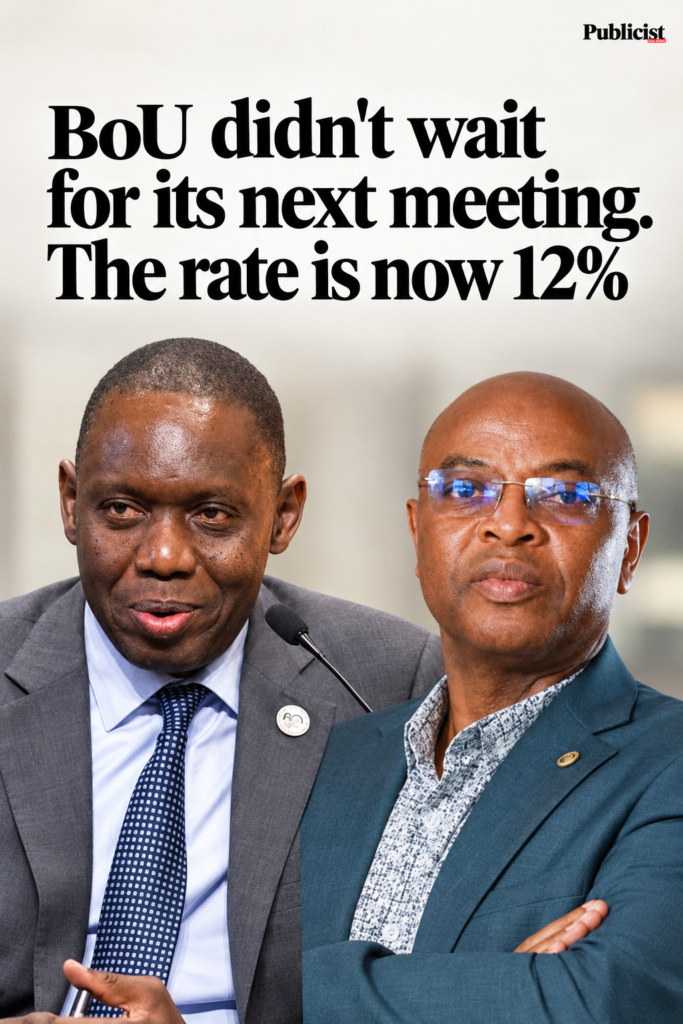

The Uganda Shilling has been under pressure, but Bank of Uganda (BOU) Governor Michael Atingi-Ego does not believe that automatically gives the central bank reason to intervene.
The Shilling weakened by about 3.2 percent against the US dollar year on year in July 2026 and by 1.3 percent on a quarterly basis. The pressure has been linked to geopolitical uncertainty and increased demand for dollars from companies in the oil, manufacturing and telecommunications sectors.
For businesses paying suppliers abroad, importing machinery or carrying dollar denominated obligations, such movements have an immediate impact. More Shillings are required to meet the same foreign currency obligation.
The natural question is why BOU does not simply intervene and support the currency. Atingi-Ego’s answer is that the threshold for intervention is not simply whether the Shilling is weakening.
“Intervention is based on smoothing out excessive volatility,” he said during the August monetary policy discussions, adding that such conditions had, to the best of his knowledge, not emerged in the market.
Uganda operates a flexible exchange rate regime in which the price of the Shilling is largely determined by demand and supply.
BOU can intervene in the interbank foreign exchange market when it considers volatility excessive or market conditions disorderly, but it does not ordinarily intervene to maintain a predetermined exchange rate.
The Uganda Shilling has weakened against the dollar over the past year, but Bank of Uganda has resisted calls for aggressive intervention. Governor Michael Atingi-Ego’s explanation provides an important insight into how the central bank views the currency: movement in the exchange rate does not necessarily mean that the foreign exchange market is in trouble.
This is not a new policy position. The International Monetary Fund’s review of BOU’s transparency framework describes the central bank’s approach as allowing the Shilling to adjust to underlying economic pressures while intervening to smooth excessive volatility.
That means there is no official exchange rate that BOU is trying to defend.
Although the Shilling was weaker when compared with a year earlier, Ministry of Finance data show that it actually appreciated by 0.2 percent during July, trading at an average mid rate of Shs3,704.51 to the dollar, compared with Shs3,710.64 in June.
Foreign exchange inflows from remittances, portfolio investment and export earnings from agriculture, mining and energy helped support the currency during the month.
The Shilling can therefore depreciate over a twelve month period while appreciating over a single month. For the central bank, what matters is not simply the direction of travel, but the nature and severity of the movement.
Commercial bank traders are seeing much the same interaction between demand and supply. Richard Nsubuga, Acting Head of Trading, CIB Markets at Absa Bank Uganda, recently attributed pressure on the Shilling to foreign currency demand from the energy and manufacturing sectors as well as activity within the interbank market.
As the week progressed, however, increased inflows from commodity exporters and remittances, together with softer corporate demand, helped the currency recover some of its earlier losses.
Nsubuga expects the Shilling’s near term performance to depend largely on the balance between corporate demand for foreign currency and inflows from exporters and remittances.
That market commentary is important because it illustrates the point Atingi-Ego is making.
The exchange rate is responding to identifiable economic flows. Companies are buying dollars, exporters are bringing dollars into the country, remittances are arriving and investors are moving capital.
The resulting movement may be uncomfortable for particular businesses without necessarily indicating that the foreign exchange market has ceased functioning normally.
BOU has the capacity to intervene. If pressure on the Shilling becomes excessive, the central bank can sell dollars into the market, increasing foreign currency supply and helping to calm volatility.
But those dollars come from Uganda’s foreign exchange reserves, and reserves have other important functions.
According to the IMF, Uganda’s gross international reserves had risen to approximately US$6.1 billion by the end of May 2026, supported by strong capital inflows. That represented about 2.7 months of imports of goods and services.
Those reserves provide the country with protection against external shocks and help maintain confidence in Uganda’s ability to meet foreign currency obligations.
Using them repeatedly simply to prevent the Shilling from adjusting to normal demand and supply would come at a cost.
It could reduce the country’s protection against a more serious external shock and create an expectation among businesses and investors that BOU will protect them whenever exchange rate movements become uncomfortable.
That would be difficult to reconcile with a genuinely flexible exchange rate.
The IMF has continued to support Uganda maintaining exchange rate flexibility, with intervention focused on disorderly market conditions while reserves are strengthened.
This does not mean BOU is indifferent to a weaker Shilling. The central bank’s primary concern is price stability, and sustained currency depreciation can eventually affect inflation.
Uganda imports fuel, machinery, pharmaceuticals, industrial inputs and consumer goods. When the Shilling weakens, the local currency cost of some of those imports increases. Businesses may eventually pass part of that increase to consumers.
Headline inflation rose to 4.0 percent in July from 3.7 percent in June, according to government data. Higher utility costs, fuel prices, food prices and transportation costs contributed to the increase.
Those numbers deserve attention, but they do not yet suggest an inflation crisis. Inflation remains around BOU’s medium term target range, while the central bank has continued to emphasise the importance of maintaining macroeconomic stability.
This is where exchange rate management and monetary policy meet. A depreciation that reflects ordinary market adjustment is one thing. A rapid and disorderly fall that begins destabilising prices, inflation expectations or financial markets is another. The latter is much more likely to trigger intervention.
There is also no exchange rate that works equally well for every part of the economy. Importers generally benefit from a stronger Shilling because they need fewer Shillings to purchase foreign currency. Companies servicing dollar denominated debt face a similar calculation.
Exporters can experience the opposite effect. Coffee exporters, tourism operators and other businesses earning dollars may receive more Shillings when those earnings are converted into local currency.
Bank of Uganda therefore cannot sensibly manage the exchange rate around the interests of either importers or exporters.
Its responsibility is the stability of the economy as a whole. That requires allowing the foreign exchange market to perform one of its basic functions, which is finding a price at which demand for foreign currency meets available supply.
Atingi-Ego’s comments ultimately point to a wider misunderstanding about currencies.
Exchange rate stability does not mean that the Shilling should remain at the same level indefinitely. Uganda’s currency has to absorb changes in import demand, commodity prices, export earnings, remittances, capital movements and geopolitical conditions. Some movement is inevitable.
Recent experience demonstrates this quite clearly. The Shilling weakened on an annual basis as corporate dollar demand and international uncertainty increased. Within July itself, however, stronger remittances, portfolio flows and export earnings helped it appreciate slightly.
Those are precisely the adjustments that a flexible foreign exchange market is expected to make.
The test for BOU is therefore not simply whether the Shilling is rising or falling. It is whether the market continues to function in an orderly manner and whether currency movements begin threatening price stability and confidence in the wider economy.
For now, Atingi-Ego’s message is that this threshold has not been reached. The Shilling may be under pressure, but that does not necessarily mean it needs defending.