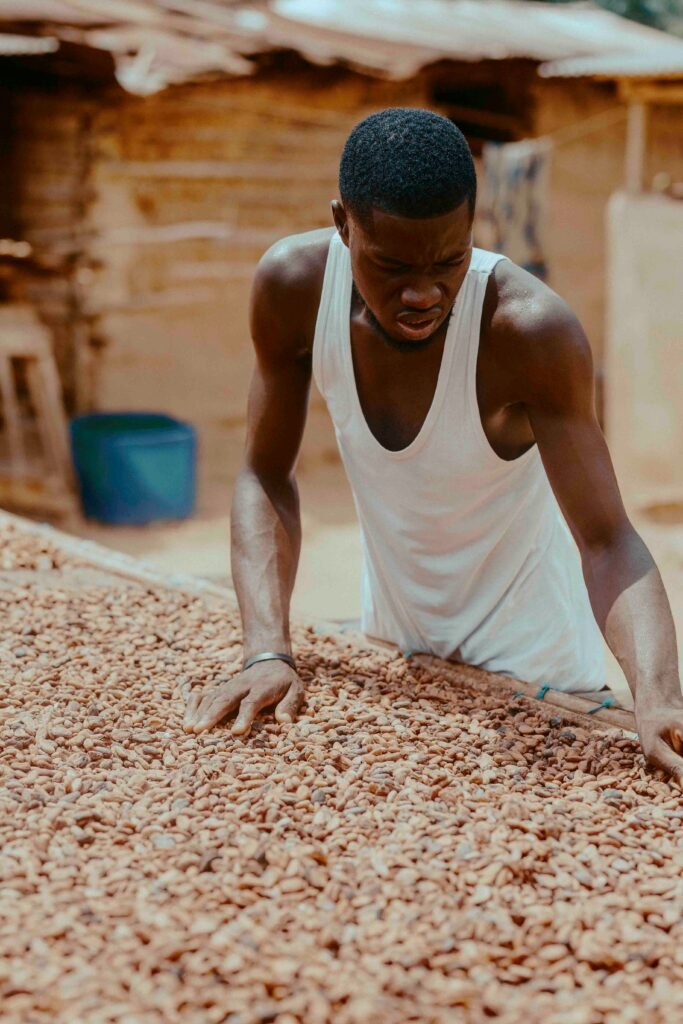
Uganda’s cocoa industry is entering a new phase. The crop is no longer a small agricultural story; it is becoming a significant export business. The opportunity now is to build the businesses and infrastructure around it so that more of the value generated by cocoa stays in Uganda.
According to figures from the Ministry of Agriculture, Animal Industry and Fisheries reported in January 2026, Uganda’s cocoa export earnings rose from about $70.6 million to $620.4 million, making cocoa the country’s second-largest agricultural export after coffee.
That figure needs some context. Uganda has not increased cocoa production ninefold. Global cocoa prices rose sharply during the period, meaning part of the increase in export earnings came from higher prices rather than volumes alone. Even so, Uganda’s physical exports have also been growing. The country exported 56,094 tonnes of cocoa beans between March 2024 and February 2025, compared with 50,539 tonnes in the previous 12 months and 35,596 tonnes between March 2022 and February 2023.
The combination of rising volumes and strong international prices has created something Uganda has not always had around emerging crops: a sizeable commercial market capable of supporting an ecosystem of businesses.
That is where the next opportunity lies. Uganda already has cocoa production across districts including Bundibugyo, Buikwe, Mukono, Jinja, Masindi, Hoima, Mubende, Mayuge, Mpigi, Luweero, Masaka and Kasese. For farmers, cocoa is attractive because it is a perennial crop that can produce for years once established and can be integrated into agroforestry systems.
But producing the bean is only one part of the business. As the industry expands, somebody has to supply quality seedlings, aggregate cocoa from smallholders, manage fermentation and drying, provide storage and quality testing, handle logistics, establish traceability systems and connect farmers to exporters and international buyers. These are businesses in their own right, and they offer an entry point for agripreneurs who may never own a large cocoa plantation.
The larger opportunity comes further down the value chain. Uganda exported cocoa largely as beans, but the same crop can be processed into cocoa liquor, butter and powder and ultimately into chocolate and other consumer products. Every additional stage of processing creates another opportunity for local businesses to earn from the crop.
This is where cocoa can learn from coffee. Uganda’s coffee industry generated a record $2.2 billion in exports in FY2024/25, with the value chain supporting an estimated 12.5 million Ugandans. Coffee’s scale is the result of decades of investment in farmer networks, research, processing, financing, quality systems, logistics and relationships with international buyers.
Cocoa does not yet have the same depth. Its rapid rise therefore presents both an opportunity and a warning. Uganda can use the current momentum to build the systems needed to support a durable industry, or it can remain primarily a supplier of raw beans and leave much of the higher-value business elsewhere.
The broader agricultural numbers show why this matters. MAAIF says Uganda’s agricultural export earnings increased from $1.66 billion in FY2020/21 to $4.18 billion in FY2024/25, accounting for 38.5% of the country’s total exports. The growth of cocoa is part of this wider shift towards commercially significant agricultural exports.
For entrepreneurs, the message is that the opportunity does not necessarily begin with owning land. A young entrepreneur could build a nursery supplying farmers with reliable planting material. Another could establish an aggregation business linking smallholders to buyers. Others could invest in fermentation, drying, storage, transport, quality assurance or digital traceability. With sufficient capital and market access, businesses further along the chain could move into processing, packaging and Ugandan chocolate brands.
The challenge is making these businesses viable. Farmers need consistent markets and better access to finance. Aggregators need working capital. Processors need reliable volumes of quality cocoa. Exporters need efficient logistics and traceability. Manufacturers need technology, food-safety systems and strong consumer markets.
That means Uganda’s cocoa story should not be measured only by how much cocoa leaves the country or how much export revenue appears in the statistics.
The bigger measure will be how much economic activity is created before the beans leave Uganda.
The recent surge in export earnings may not last indefinitely. Global cocoa prices will eventually change, and when they do, the strength of Uganda’s industry will depend less on the price of the bean and more on productivity, quality, processing capacity and market access. The cocoa boom has therefore created a window for entrepreneurs and investors to move early.
Uganda does not have to wait for cocoa to become another coffee. It can build a distinct cocoa economy around the production already taking place. The opportunity is no longer simply to grow more cocoa. It is to build the industry around the bean.
Editor’s Note: This article is part of the I’mAnAgripreneur thought leadership series by Publicist East Africa, exploring the ideas, policies, market innovations and investment opportunities shaping the future of agriculture, agribusiness and industrialisation across East Africa.