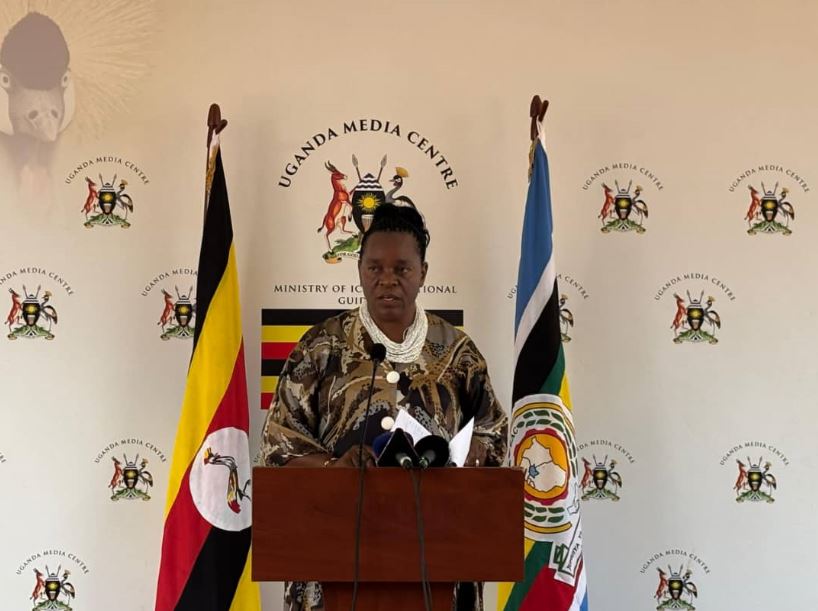
As Uganda prepares to mark International Literacy Day on September 8, 2025, the nation stands at a critical juncture. While celebrating significant progress, the Ministry of Gender, Labour and Social Development, Hon. Peace Regis Mutuuzo, has issued a powerful call to action: to tackle the pervasive challenge of illiteracy by promoting skills for the digital era.
The Minister revealed today during a presser at the Uganda Media Centre that with a new, massive investment of Shs83 billion, the government is launching a renewed effort to equip millions of Ugandans with the tools needed to thrive in a digital-first economy.
Literacy and the Digital Divide
Hon. Mutuuzo revealed that Uganda has made remarkable strides in education, with a national literacy rate of 76% as of 2024, according to the Uganda Bureau of Statistics (UBOS).
According to the Minister, this success, however, is tempered by a stark reality: an estimated 11.9 million Ugandans remain illiterate, with a disproportionate number being women.
“In an age where digital literacy, the ability to use mobile money, send an email, or access online services, is a prerequisite for economic participation, this illiteracy gap threatens to widen the divide between the connected and the marginalised,” Hon. Mutuuzo said.
“The theme for this year’s International Literacy Day, ‘Promoting Literacy in the Digital Era’, is therefore not merely a slogan, but a recognition of a foundational challenge to national progress,” she reiterated.
A History of Commitment: From FAL to PDM
She highlighted that Uganda’s commitment to literacy is deeply rooted in its national policies, including Article 30 of the Constitution and the Sustainable Development Goals (SDG 4).
The Minister revealed that this journey began with foundational programs like Universal Primary Education (UPE) in 1997, which saw primary school enrollment skyrocket.
Later, the Functional Adult Literacy (FAL) program empowered millions of youth and adults with essential literacy and numeracy skills, laying the groundwork for greater socio-economic participation.
This evolution in policy, according to Hon. Mutuuzo, has culminated in the Integrated Community Learning for Wealth Creation (ICOLEW) program, which directly links learning to livelihood skills and the government’s flagship Parish Development Model (PDM).
This approach, she pointed out, moves beyond traditional classroom-based learning to embed education within the very fabric of community-led development.
A Future of Investment and Innovation
In a major move, the Minister revealed that the government has approved the nationwide scale-up of this model with the new Support to the Implementation of Integrated Community Learning for Wealth Creation (SUICOLEW) program.
“From the financial year 2025/26, a total of Shs83 billion will be dedicated over five years to establishing and strengthening community learning centres and expanding digital literacy across the country,” the Minister said.
This investment, she noted, is more than a budget allocation; it is a strategic alignment with key national frameworks, including the NDP IV and the NRM Manifesto.
She explained that by equipping marginalised groups, especially women and youth, with literacy, numeracy, and livelihood skills, the program directly contributes to human capital development, financial inclusion, and self-reliance, which are all key pillars of the PDM.
To achieve this, Mutuuzo said the government is also working closely with numerous Non-Governmental Organisations (NGOs), Foreign Banking Organisations (FBOs), and community organisations to ensure a multi-sectoral approach to this national challenge.
The Minister’s final call for every stakeholder to unite in this effort underscores the immense task ahead.
By embracing a unified approach, Uganda can reaffirm its commitment to a future where literacy is not a privilege, but a universal right that empowers every citizen to contribute to the nation’s prosperity and socio-economic transformation.