
At the 9th High-Level Economic Growth Forum in Kampala held recently, a stark warning was delivered to Ugandan policymakers: mismanaging anticipated oil revenues and over-relying on non-tradable sectors could derail the nation’s long-term economic stability.
During the said Forum, top economists and key government figures converged to discuss a new path forward, with a strong consensus emerging around the need for fiscal discipline and a shift toward an export-led growth model.
The forum’s keynote speaker, Belgian-British economist Prof. Stefan Dercon, outlined a series of bold strategies to “get Uganda’s growth genie out of the bottle.”
He painted a sobering picture of a global environment marked by rising tariffs, declining aid, and shrinking finance flows, urging Uganda to adapt to this new reality.
Prof. Dercon stressed the critical need for Uganda to mobilise domestic resources to bridge financing gaps, arguing that the era of relying on waning concessional loans is over.
“I have learnt that supply doesn’t create demand. It also means that export supply doesn’t create export demand,” he said, adding, “It is key to have buyers. If you want to export, you need to find people who want to buy your products.”
He underscored that without a shared commitment among Uganda’s leaders and economic elites, a coordinated and visionary approach to sustained growth would be impossible.
The core of his message was a powerful cautionary note: the future of Uganda’s economy hinges on its ability to diversify and to avoid the pitfalls that have befallen other resource-rich nations.

Government’s Pledge to Empower the Private Sector
In a direct response to the keynote address, Finance Minister Matia Kasaija reaffirmed the government’s support for the private sector.
He emphasised that the government views the private sector as the primary driver of Uganda’s growth agenda.
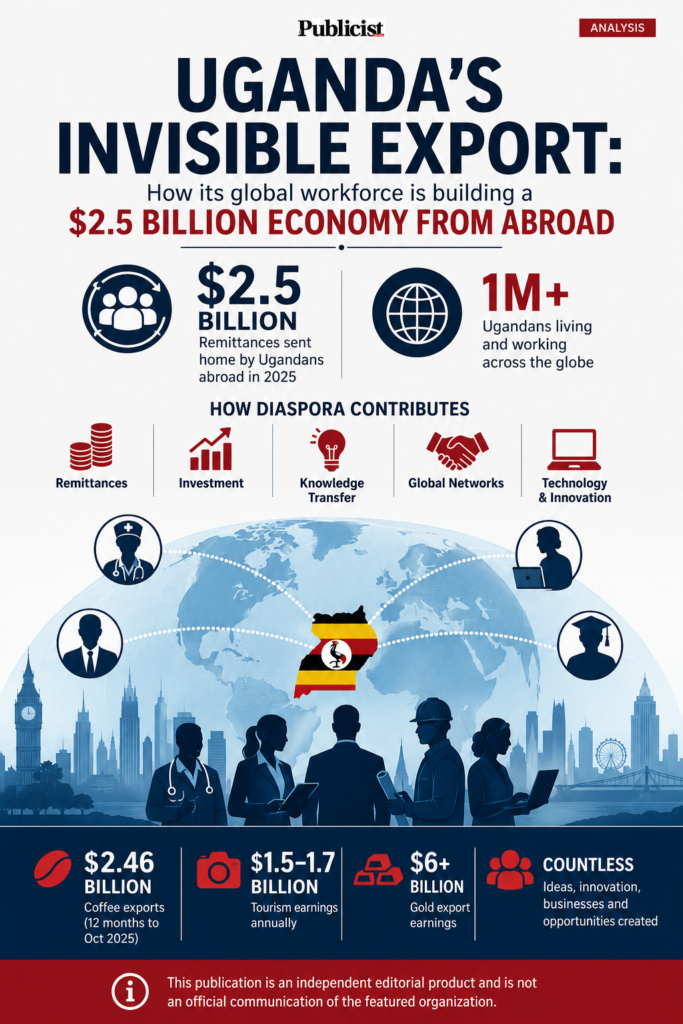
The Permanent Secretary to the Treasury, Ramathan Ggoobi, highlighted Uganda’s economic resilience and currency stability, noting that Foreign Direct Investment (FDI) inflows are at USD3.7Bn, with a record USD2.2Bn in coffee exports, a USD1.5Bn tourism recovery, and diaspora remittances, which are all anchoring the ATMs of Agro-industrialisation, Trade, Tourism and Manufacturing.
The dialogue between Prof. Dercon’s external critique and the government’s commitment highlights a crucial moment of reflection for Uganda.
The forum served as a timely and important reminder that, as Uganda stands on the verge of first oil production, its leaders must prioritise strategies that build a resilient, diverse, and sustainable economy for the long term.
The message is clear: the country’s success will be measured not by the oil it extracts, but by the fiscal discipline and export-driven growth it cultivates.