The Uganda Railways Corporation (URC), under the leadership of Benon M. Kajuna as Managing Director, has a bold vision: to become the “Preferred Freight and Passenger Transporter in Eastern Africa by 2040.” However, a new report by the Auditor General, Edward Akol, reveals a stark reality. The URC is sinking under a tide of financial abuse, operational chaos, and severe neglect of its core infrastructure.
This internal meltdown paints a grim picture of a corporation far from ready to even manage its current mandate, let alone lead the charge for the multi-billion-dollar Standard Gauge Railway (SGR).
The SGR, for all its promise, remains a distant and “fleeting illusion” until these fundamental failures are addressed.
Financial Rot and a Crisis of Accountability
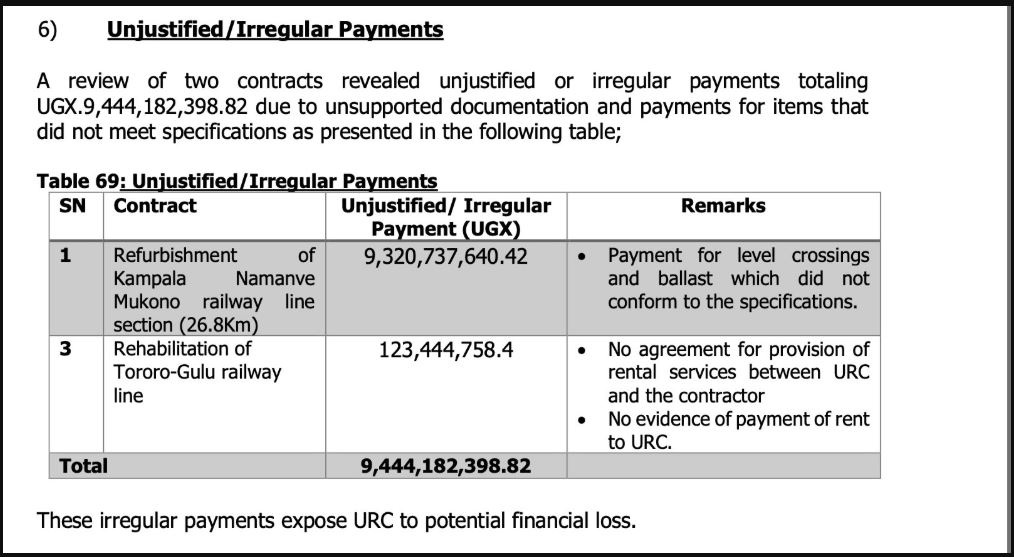
The Auditor General’s report uncovers a shocking lack of financial discipline and accountability. A review of just two contracts exposed a staggering UGX 9.44 billion in irregular or unjustified payments. This included a payment for the refurbishment of the Kampala–Namanve-Mukono railway line, where funds were released for materials like ballast and level crossings that did not meet specifications.
Even more troubling, the report found that for a separate contract on the Tororo-Gulu line, there was no agreement for rental services and no evidence of payment to URC by the contractor, raising serious suspicions of financial misappropriation.
This culture of fiscal mismanagement suggests that even if funding for the SGR were secured, there is no guarantee it would be used transparently or effectively.
Crumbling Infrastructure
The operational failures are a direct consequence of a severely dilapidated railway network. The Auditor General’s findings on the state of URC’s assets are alarming:
Out of 1,420 wagons, 774 are not in good condition, with 198 classified as scrap.
Only 11 out of 51 locomotives are active.
Just 2 out of 5 ferries are in use.
The report also indicates that the physical railway network itself has shrunk from 1,266 kilometres to a mere 269 kilometres currently in operation.
Routes that once connected vital regions, like the line to the West Nile, are now “untraceable” due to inadequate maintenance, theft, and vandalism. With a maintenance budget funded by only 35%, the decay of infrastructure is a predictable outcome.
Failing to Deliver to Expectations
The state of URC’s assets directly impacts its ability to meet its targets, resulting in massive losses in the following ways.
Passenger Services
The corporation failed to hit its three-year passenger target by a staggering 73.6%, carrying only 837,528 passengers against a target of 3.178 million. The report revealed that passenger services operate at a significant loss of approximately UGX 1.179 billion over the audited period, as revenue cannot even cover estimated operational costs.
Cargo Freight Shortfalls
The situation is even worse for cargo, which is URC’s main business. The corporation fell short of its target by 47.66%, unable to fulfil customer orders due to a critical shortage of specialised wagons and active locomotives. This resulted in a missed revenue opportunity of over US$1.5 million for import cargo and US$716,500 for export cargo. The report notes low customer retention and frequent delays, with only 67% of trains departing on time.
The report also highlights a critical human resource gap of 404 staff, particularly in technical departments, which severely compromises URC’s operational capacity.
The inability to manage its existing infrastructure, meet targets, and prevent financial leakages makes it clear that until the URC can undergo a radical internal transformation, the promise of a modern, fast, and efficient railway system for Uganda will remain an unachievable dream.