Across rural Tanzania, a modest government financing programme is beginning to signal something far larger than its size suggests.
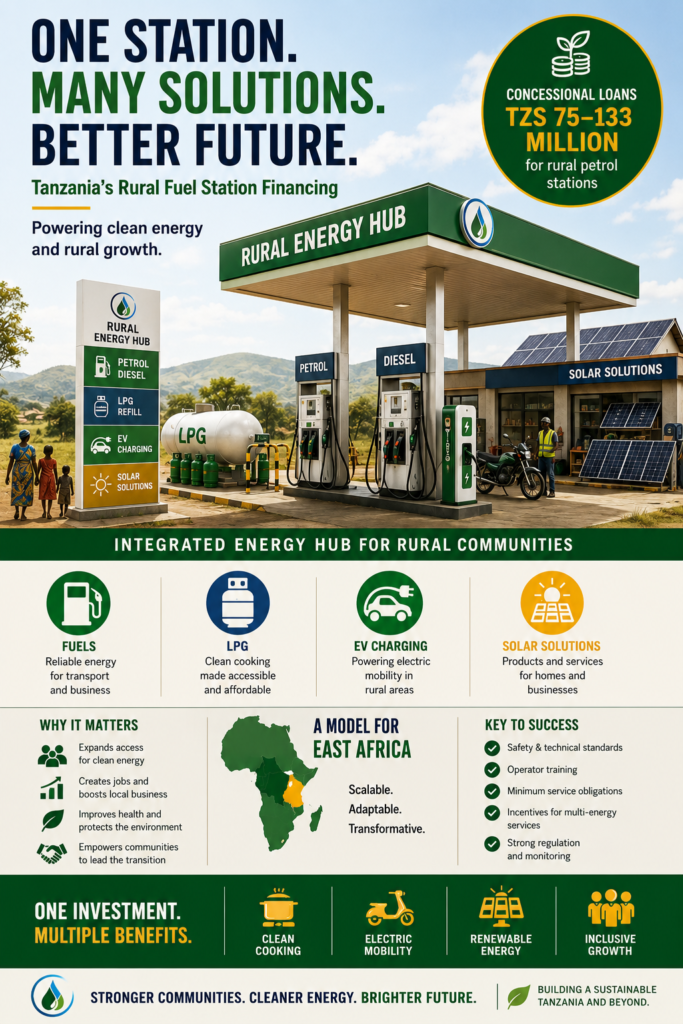
The initiative, which offers concessional loans ranging from TZS 75 million to TZS 133 million for the development of rural petrol stations, may appear to be another SME financing scheme. In reality, it has the potential to redefine how modern energy reaches rural communities by creating integrated energy hubs that serve far more than motorists.
If implemented strategically, these stations could become multi-service centres that combine conventional fuel retail with LPG distribution, electric vehicle (EV) charging infrastructure, and solar energy products and services. Such a model would represent an important shift from single-purpose fuel outlets to decentralised energy platforms capable of supporting multiple aspects of rural development.
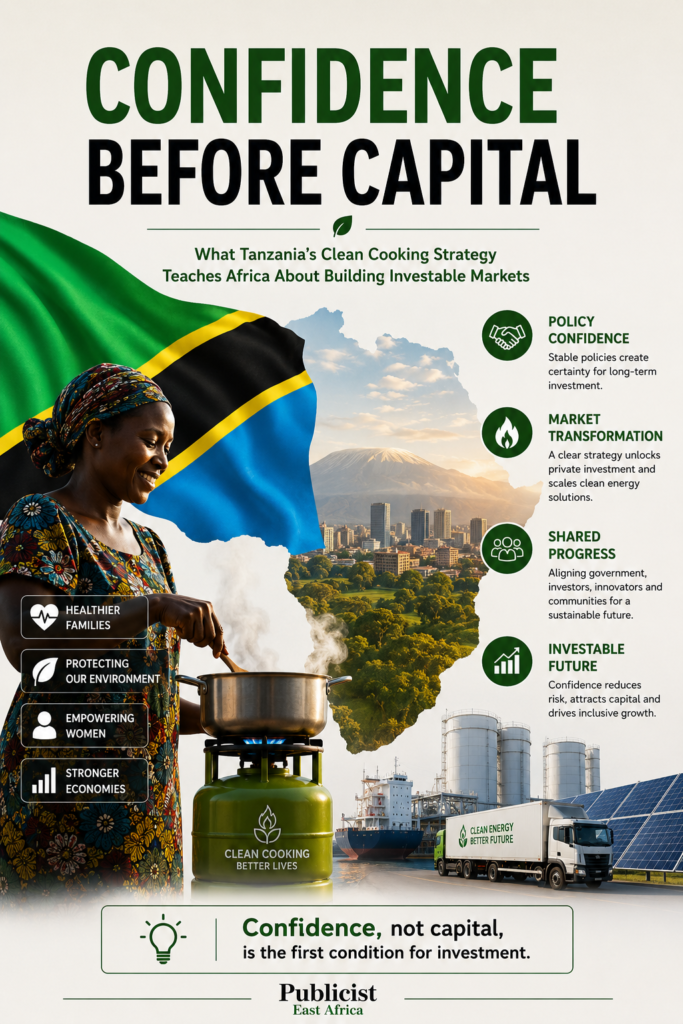
Tanzania’s rural energy challenge has never been a lack of ambition. The country’s National Clean Cooking Energy Strategy 2024–2034 seeks to increase clean cooking adoption from less than 7% of households to 75% by 2030, while institutions such as the Rural Energy Agency (REA) continue expanding access to electricity and off-grid energy solutions.
The greater challenge lies in the “last mile.”
Governments can introduce subsidies, develop sound policies and mobilise financing, but without reliable distribution infrastructure close to rural communities, access remains limited. The rural petrol station financing programme addresses this critical gap by strengthening the physical infrastructure through which modern energy can reach households and businesses.
Rather than functioning solely as fuel stations, these facilities could evolve into integrated rural energy hubs.
They can distribute LPG, making clean cooking fuels more accessible and reliable for households that currently travel long distances to refill cylinders. They can support the rollout of electric mobility by providing charging facilities for motorcycles, three-wheelers and small electric vehicles as rural transport gradually electrifies. They can also become trusted retail and service centres for solar home systems, productive-use equipment and other decentralised energy technologies.
Individually, each of these services represents incremental progress. Together, however, they create a distributed energy ecosystem embedded within rural economies.
The significance of this approach extends beyond Tanzania.
Across East Africa, governments are pursuing ambitious clean energy transitions while confronting many of the same structural challenges, limited rural infrastructure, fragmented energy distribution networks and the high cost of expanding multiple standalone systems. Countries such as Uganda, Kenya and Rwanda could draw valuable lessons from Tanzania’s approach if the model proves successful.
The programme also demonstrates an important principle in infrastructure planning: one physical asset can deliver multiple public benefits.
Instead of constructing separate distribution networks for LPG, EV charging and solar products, policymakers can layer complementary services onto existing commercial infrastructure. This reduces investment costs, improves commercial viability and creates stronger business cases for private operators while expanding access for rural communities.
Equally important, the model positions rural communities not as passive recipients of government programmes but as active participants in the energy transition. Local entrepreneurs become energy distributors, rural businesses gain access to new commercial opportunities and households benefit from improved access to cleaner, more reliable energy services.
The programme’s success, however, will depend less on the size of the loans than on the quality of implementation.
Safety standards for LPG handling, technical requirements for EV charging infrastructure, minimum service obligations, operator training and clear incentives for integrating multiple energy services will all determine whether these facilities become genuine rural energy hubs or remain conventional petrol stations with a few additional offerings.
Without thoughtful implementation, the programme risks delivering only incremental improvements.
With strong design, it could establish a scalable model for integrated rural energy infrastructure across East Africa.
As governments across the region seek practical pathways towards cleaner energy, rural electrification and inclusive economic growth, Tanzania’s initiative offers an important lesson: transformative infrastructure does not always begin with billion-dollar investments. Sometimes it begins by reimagining familiar assets and asking them to do more.
The humble rural petrol station may soon become something much greater than a place to buy fuel. It could become the foundation of East Africa’s next generation of decentralised energy systems, bringing clean cooking, electric mobility and renewable energy together through one locally anchored, commercially sustainable platform.
If that vision is realised, Tanzania will not simply have financed rural petrol stations. It will have laid the groundwork for a more integrated, resilient and inclusive rural energy future.