When thousands of runners descended on Kasese for the fifth Tusker Lite Rwenzori Marathon, they came to run. But the activity surrounding them told a much bigger story.
Hotels received guests, restaurants served visitors, transport operators moved people around the region and businesses interacted with thousands of consumers. For a weekend, Kasese and the Rwenzori region commanded the attention of runners, tourists, corporate Uganda and a growing international audience.
This is what makes the marathon interesting beyond sport. It is becoming part of Uganda’s emerging experience economy, economic activity generated when people travel and spend not simply to see a place, but to participate in something memorable there.
The Tusker Lite Rwenzori Marathon is becoming more than one of Uganda’s biggest sporting events. Its growth shows how tourism, corporate investment and memorable experiences can combine to create economic value around a destination.
The marathon has come a considerable distance since its launch in 2022. The 2026 edition was staged as a World Athletics Label Road Race, strengthening its international standing, while government support has grown alongside the event.
Yet perhaps the more interesting measure of its success lies outside the race itself.
The 42-kilometre route begins around the Equator at Kikorongo and heads towards Kasese against the backdrop of the Rwenzori Mountains. Here, the landscape is not simply scenery; it is part of the experience.
A runner travelling to Kasese needs somewhere to sleep, somewhere to eat and transport to move around. Some visit surrounding attractions, extend their stay or return later with family and friends. The economic footprint therefore extends well beyond registration fees and prize money.
For Uganda’s tourism industry, there is an important lesson here. The country has spent decades marketing its natural assets, gorillas, wildlife, mountains, lakes and national parks. Those assets remain immensely valuable, but destinations can extract considerably more value when they create compelling experiences around them.
The Rwenzori Marathon does precisely that. Instead of simply telling somebody that western Uganda is beautiful, it gives them a reason to travel there and experience it.
The growing corporate ecosystem around the marathon is another indication of its evolution.
Coca-Cola Beverages Uganda (CCBU), for example, returned in 2026 for its fifth consecutive year as Official Hydration Partner, investing UGX 215 million and supplying Rwenzori Pure Natural Mineral Water across the race categories.
The partnership makes sense because hydration is not simply branding around a marathon; it is part of what makes the event work. This year, CCBU also introduced a 350ml Rwenzori Pure Natural Mineral Water pack designed with runners in mind, a simple example of a product becoming part of the consumer experience rather than merely appearing alongside it.
CCBU Managing Director Emmy Hashakimana captured the wider opportunity ahead of the race:
“The Tusker Lite Mount Rwenzori Marathon has become an important platform for bringing people together, creating economic opportunities and showcasing the beauty and potential of the Rwenzori region.”
Hashakimana also linked the company’s participation to creating shared value for communities while delivering positive experiences for consumers.
That idea of shared value is where the conversation becomes more interesting. If events such as the Rwenzori Marathon are becoming economic platforms, what role should the private sector play beyond conventional sponsorship?
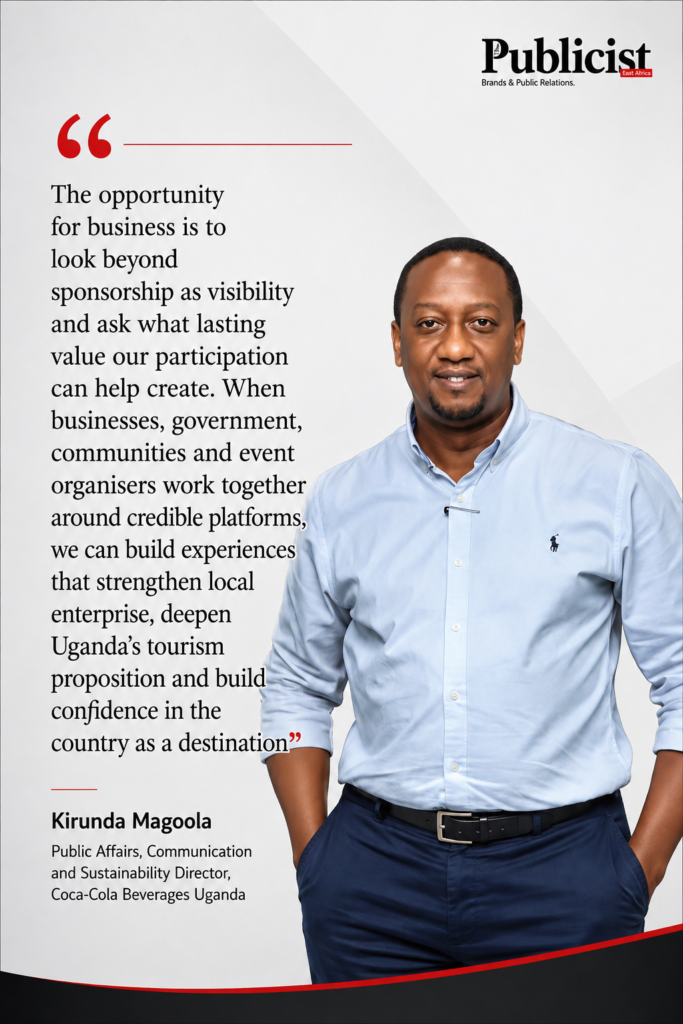
“The opportunity for business is to look beyond sponsorship as visibility and ask what lasting value our participation can help create. When businesses, government, communities and event organisers work together around credible platforms, we can build experiences that strengthen local enterprise, deepen Uganda’s tourism proposition and build confidence in the country as a destination’’ said Kirunda Magoola, Public Affairs, Communication and Sustainability Director, Coca-Cola Beverages Uganda
‘’For companies, that means being deliberate about the role we play. Sustainable partnerships are strongest when there is a genuine connection between the needs of an experience, the communities around it and what a business can responsibly contribute. That is how corporate participation moves from presence to impact.” he adds.
A company that simply buys visibility receives exposure. One that solves a real need within an experience can become part of what makes that experience successful.
CCBU’s five-year association illustrates another point: consistency matters. Long-term participation allows a company to build an association with a property as it grows, while the event itself benefits from partners prepared to invest beyond a single edition.
CCBU is not alone. Britam Uganda also returned for a fourth consecutive year in 2026, committing UGX 100 million to the marathon. The presence of long-term corporate partners suggests that the event is increasingly being viewed not simply as a race, but as a platform with sustained commercial and social value.
The bigger opportunity for Uganda
The opportunity is therefore bigger than one marathon. Uganda possesses natural and cultural assets capable of supporting more home-grown experiences that attract visitors, corporate investment and international attention. Sport, conservation, culture, food and adventure can all become reasons for people not merely to visit a destination, but to stay longer and spend more while they are there.
For communities, that can mean customers for accommodation, restaurants, transport, guides and local enterprises. For tourism agencies, it creates new reasons to market Uganda. For companies, it provides credible platforms through which businesses can engage consumers while contributing to economic activity.
This is why the ambition should ultimately be bigger than organising successful events.
Uganda should be building properties; distinctive experiences with their own identities, communities, commercial ecosystems and year-after-year value.
Five editions into its journey, the Tusker Lite Rwenzori Marathon is beginning to show what that can look like.
The runners eventually cross the finish line in Kasese. The bigger question is how much lasting economic value Uganda can build around the journey that takes them there.